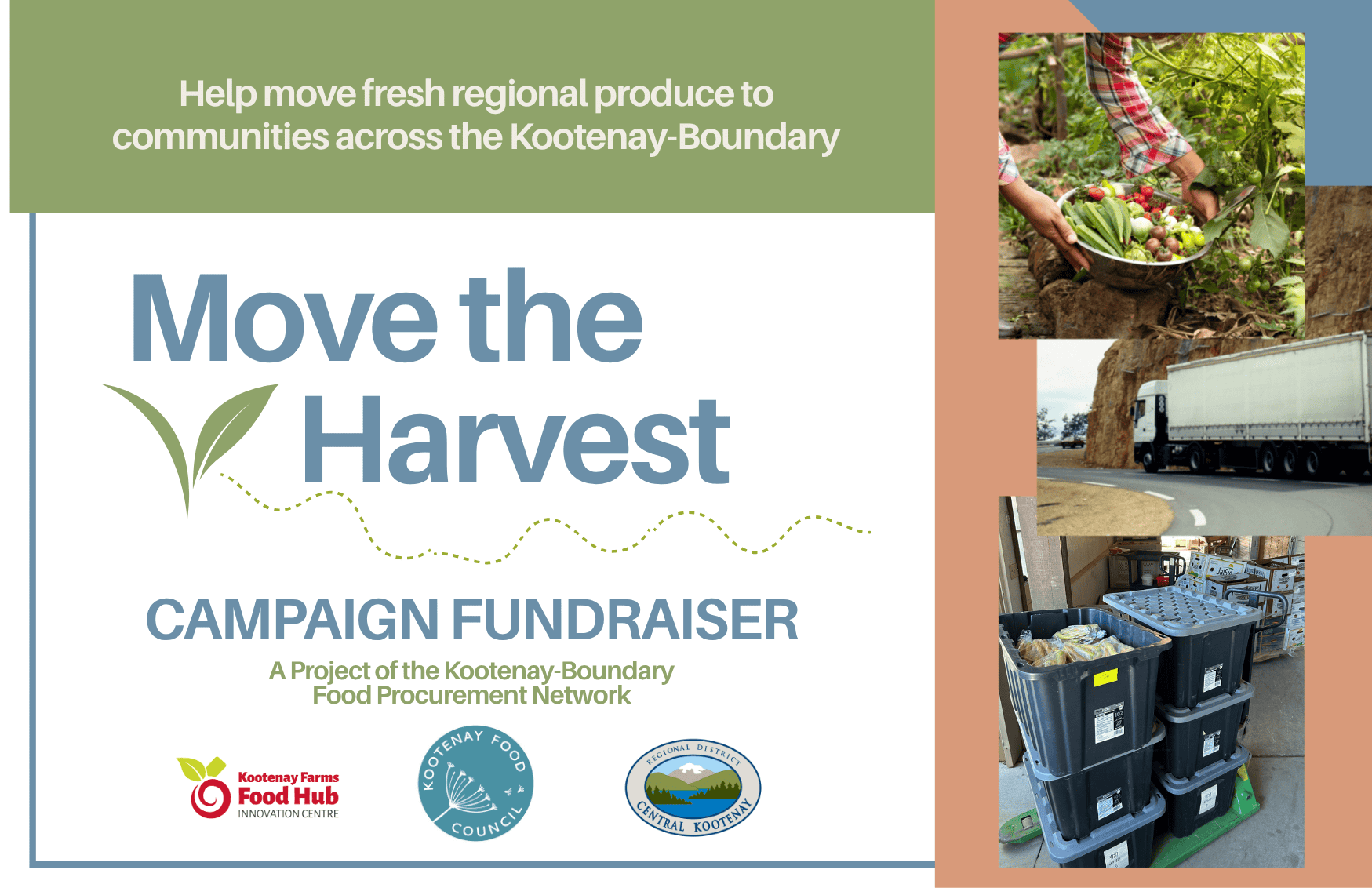
Move the Harvest Campaign

Campaign Overview
This growing season, up to 5,000bs of excess fresh regional produce is expected to be available through Kootenay Farms Food Hub in Creston. But in a rural region like ours, having food available is only part of the story. The real challenge is often transportation.
Move the Harvest raises funds to help cover the direct costs of moving excess produce from Creston to food access organizations across the Kootenay-Boundary region.
Funds raised through this campaign will support transportation, warehousing, last-mile delivery, and basic supplies such as boxes or bins. The goal is simple: help ensure good food does not remain stranded because of the cost of moving it.
How It Works
Produce is recovered, stored, processed, and boxed in Creston through Kootenay Farms Food Hub.
From there, food is transported to Castlegar, where it can be temporarily stored, sorted, and coordinated for redistribution.
Food recovery opportunities are shared through the network, with support from the Kootenay-Boundary Food Procurement Network to notify participating food access organizations.
The food is then sent from Castlegar to participating food banks and food access organizations across the region.
Why This Matters
- Fresh produce is essential for healthy communities.
- Excess produce can help food access organizations stretch limited resources further.
- Transportation costs are a major barrier for rural food access organizations.
- Food that goes unused does not reach its highest purpose: feeding people.
- Local solutions strengthen regional food security for all.
Campaign Goal
Our goal is to move an estimated 5,000 pounds of excess produce this growing season.
By donating, you help cover the practical costs of getting food from where it is available to where it is needed. This includes transportation from Creston to Castlegar, last-mile delivery to food access organizations, warehousing, and basic supplies required to move and redistribute produce safely.
What Your Donation Supports
- Transportation from Creston to Castlegar.
- Storage and handling at Castlegar Warehousing.
- Last-mile delivery to participating food access organizations.
- Basic supplies such as boxes, bins, and other packing materials.
- The practical logistics needed to move fresh food across a rural region.
The Bigger Picture
Move the Harvest is an immediate seasonal response to a practical need, but it also points toward a larger shift in how food moves through the Kootenay-Boundary region.
Across the region, producers, food hubs, food access organizations, institutions, and community partners are all working within the same food system. What is still emerging is the shared infrastructure needed to connect them.
Transportation, aggregation, warehousing, and coordinated distribution are essential pieces of a resilient regional food system.
This campaign helps address a practical barrier now while contributing to a longer-term vision for regional food procurement and logistics. Over time, this work could support shared purchasing, product aggregation, coordinated delivery, food recovery, and redistribution models that make local food more accessible to organizations, businesses, and communities.
By supporting Move the Harvest, donors and sponsors are helping move food this season while strengthening the relationships, infrastructure, and learning needed to build a more connected regional food system.
Help Move The Harvest!
There is fresh food available in our region. The missing piece is getting it where it needs to go.
Your donation helps unlock fresh regional produce, reduce food waste, and support the organizations feeding our communities.
Donate today to help move the harvest.
Exploring Regional Food Procurement Viability and Business Models
Regional Food Procurement Social Enterprise Project
The Regional Food Procurement Social Enterprise project, led by the Kootenay Food Council, is exploring new ways to better connect and strengthen the food system across the Kootenay region.
Why This Work Matters
Over the past several years, the region has worked to further local food initiatives such as school food programs, food hubs, increased supports for farms as well as food-based businesses. However, the broader system for sourcing, purchasing, and distributing food is still largely disjointed. Many organizations operate independently, with limited alignment when it comes to logistics, warehousing, and transportation.
As a result, the region continues to face:
- Higher operating and distribution costs
- Underutilized infrastructure
- Missed opportunities for local producers to access markets
- Ongoing loss of food spending outside the region
In recent years, these challenges have become more pronounced, further highlighting the fragility of the current system. Rising transportation costs, reduced rural delivery volumes, and disruptions such as floods, wildfires and industry closures further increase food insecurity and underscore the need for a more coordinated, resilient approach.
Project Vision
This project is working towards the development of a more connected regional food procurement and distribution system. Through a shared network, it will bring together producers, processors, retailers, suppliers, schools, community organizations, warehouses, and transporters.
By improving coordination and making better use of existing infrastructure, the initiative aims to:
- Strengthen local supply chains
- Expand access to locally produced food
- Create more stable and predictable market for regional businesses
- Improve efficiency and reduce costs across the system
- Keep more food dollars circulating in the local economy
What We’re Doing
Currently the project team is engaging with stakeholders across the food system to better understand how food moves throughout the region; from production and processing to aggregation, distribution and delivery. This work will focus on identifying how food is currently procured and distributed, key gaps, constraints and inefficiencies, opportunities for better coordination and shared services and potential models to support a regional approach.
The insights gathered will help shape a practical and sustainable model that reflects the needs of the region. Over time, this work aims to support local businesses, improve access to food, strengthen rural economies and contribute to a more resilient and self-sustaining food system.
Get Involved
We are currently connecting with organizations and businesses across the Kootenay-Boundary region to inform this work.
You can get involved by:
- Participating in a stakeholder interview to share your experiences and insights
- Staying informed as the project evolves
We welcome perspectives from across the food system, including producers, processors, suppliers, distributors, retailers, food access organizations and institutions.
If you are interested in participating or would like to learn more, please contact:
Larissa Lychenko, Project Coordinator
comms@ckfoodpolicy.ca
Kootenay-Boundary Food Procurement Network
Working together to move more local food, reduce waste, and strengthen community food access across our region.
About the Network
The Kootenay-Boundary Food Procurement Network is a collaboration of food banks, meal programs, schools, and other community food organizations. Together with local farms, food producers and retailers we’re building stronger connections so that:
- More fresh, local food reaches people in rural and underserved communities
- Surplus and seconds from farms are rescued and put to good use
- Schools and food access organizations have access to reliable and affordable food sources
- Communities benefit from collective purchasing and shared logistics
This is about creating reliable, practical systems that keep good food moving where it’s needed most.

Get Involved
The Food Procurement Network is open to food producers, community food organizations, schools, and other partners who want to strengthen local food systems in the Kootenay-Boundary.
Producers → Find reliable outlets for surplus, seconds or wholesale products
Organizations → Access affordable food through shared purchasing and improved logistics
Everyone → Help reduce waste and build a stronger, more resilient local food system
Join the Network
Interested in being part of the Kootenay-Boundary Food Procurement Network?
Fill out our Expression of Interest form
OR
Contact: Danielle Soucie
Procurement & Aggregation Coordinator - network@ckfoodpolicy.ca | (250) 354-8535
Together, we can keep good food moving.
Winter Newsletter - 2024/2025

Seasonal Reflections and Gratitude
As we close out 2024, I want to take a moment to recognize the incredible dedication and resilience of those shaping our regional food system. This year has brought its share of challenges, but it has also showcased the strength, innovation, and collaboration that define our community. From farms and food organizations to advocacy efforts and entrepreneurial ventures, your collective work lays the foundation for a more equitable and resilient future.
Thank you for your unwavering commitment to this vital work—we are stronger because of you.
With gratitude,
Fall Newsletter-2024
Fall Fairs, garlic festivals, and harvest celebrations are in full swing across the region, and while it’s a time of abundance, it’s also a time to reflect. The road to this year’s harvest wasn’t easy. Even before the wildfires, many producers were grappling with the lingering impacts of the deep winter freeze, which took a toll on stone fruit and wine grape growers. Read our Fall Newsletter here.
2024 AGM and Council Meeting at Elk Root Conservation Farm
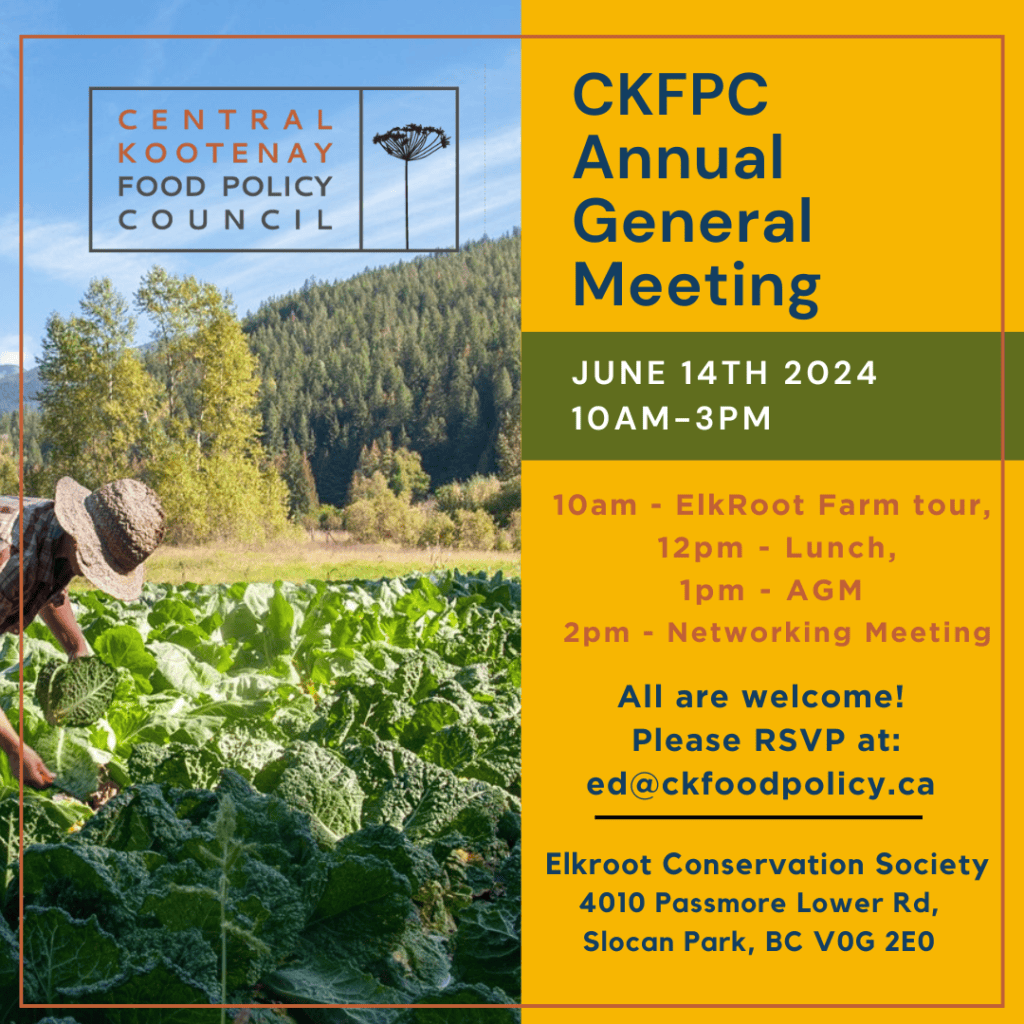
Join is on June 14th for the Central Kootenay Food Policy Council Annual General Meeting at Elk Root Conservation Society. This is a special in person Council Meeting where we will bid farewell to our parting board members and welcome in our new Executive Council.
This will also be an opportunity to learn, enjoy food and engage with other regional actors in our food system. The day begins at 10am with a Bee Safari and farm tour of Elk Root Conservation Society's Farm and operations. We’ll enjoy some food together at 12pm before conducting our AGM. Our day will then close with our regional food stakeholder Council Meeting.
The Food Policy Council Meetings are open to citizens looking to share, network and learn. Bring an update from your farm, business, organization or region, or just come and learn about the various efforts going on to address food security and resiliency in our region.
If you haven’t already confirmed your attendance, please RSVP Damon by Monday June 10th at ed@ckfoodpolicy.ca.
The venue address is: 4010 Passmore Lower rd, Slocan Park.
Winter Newsletter-2024

Have a look at our Winter 2024 Newsletter for all the fresh details about the CKFPC's latest news and project updates. If you haven't already, remember to subscribe below to get the newsletter direct to your inbox. Click to view: Winter 2024 Newsletter.
COLLABORATION AT FABX CRESTON
CKFPC AT FABx2023
Introduction:
The Central Kootenay Food Policy Council (CKFPC) was a proud sponsor and collaborator at this year's Basin Food & Buyers Expo (FABx) in Creston. Our involvement included a meaningful exploration of Yaqan Nukiy Farms, an enlightening talk by Dr. Colin Dring, and our participation in the vibrant Community Farm to Table Dinner.
Yaqan Nukiy Farms Tour
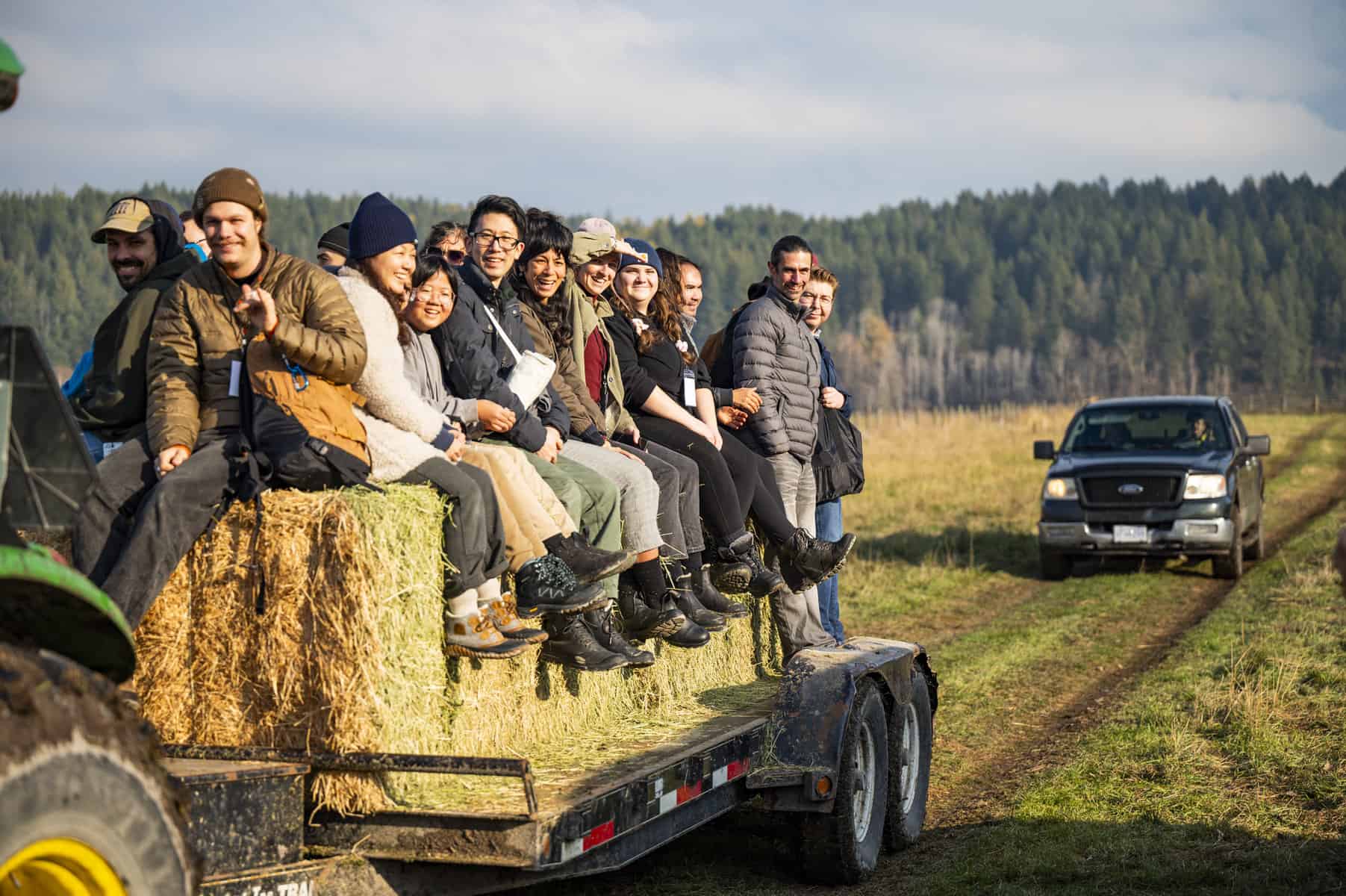
On November 3rd, 2023, CKFPC members and regional chefs had the unique opportunity to visit the Yaqan Nukiy Farms, a ranching operation of the Lower Kootenay Band (LKB). Attendees were transported via shuttle from the expo and welcomed with a tractor-pulled hay bale trailer, setting the tone for an authentic ranch experience.
The ranch manager's personal guidance offered us valuable insights into the farm's practices, seasonal operations, and its synergy with the local ecosystem. This hands-on tour provided an understanding of life and work at Yaqan Nukiy Farms, a direct connection to the livestock and insight into the care and consideration taken when working with the land.
Community Farm to Table Dinner
The Community Farm to Table Dinner, hosted in the magical setting of LKB’s Morris Flowers greenhouse, was a highlight of FABx. The evening came alive with lights, a curated menu featuring local produce, and seating for 200 guests. Chief Nasukin Louie's opening speech was a heartfelt reminder of the ongoing journey he and his people continue to walk, highlighting the power in meaningful connections and his gratitude towards local farmers that have become allies of his people.
The CKPC was honoured to support the purchase of the beef from Yaqan Nukiy Farms to serve at the dinner and to be a part of this memorable evening of rich community connection.

Exploring Food Justice with Dr. Colin Dring
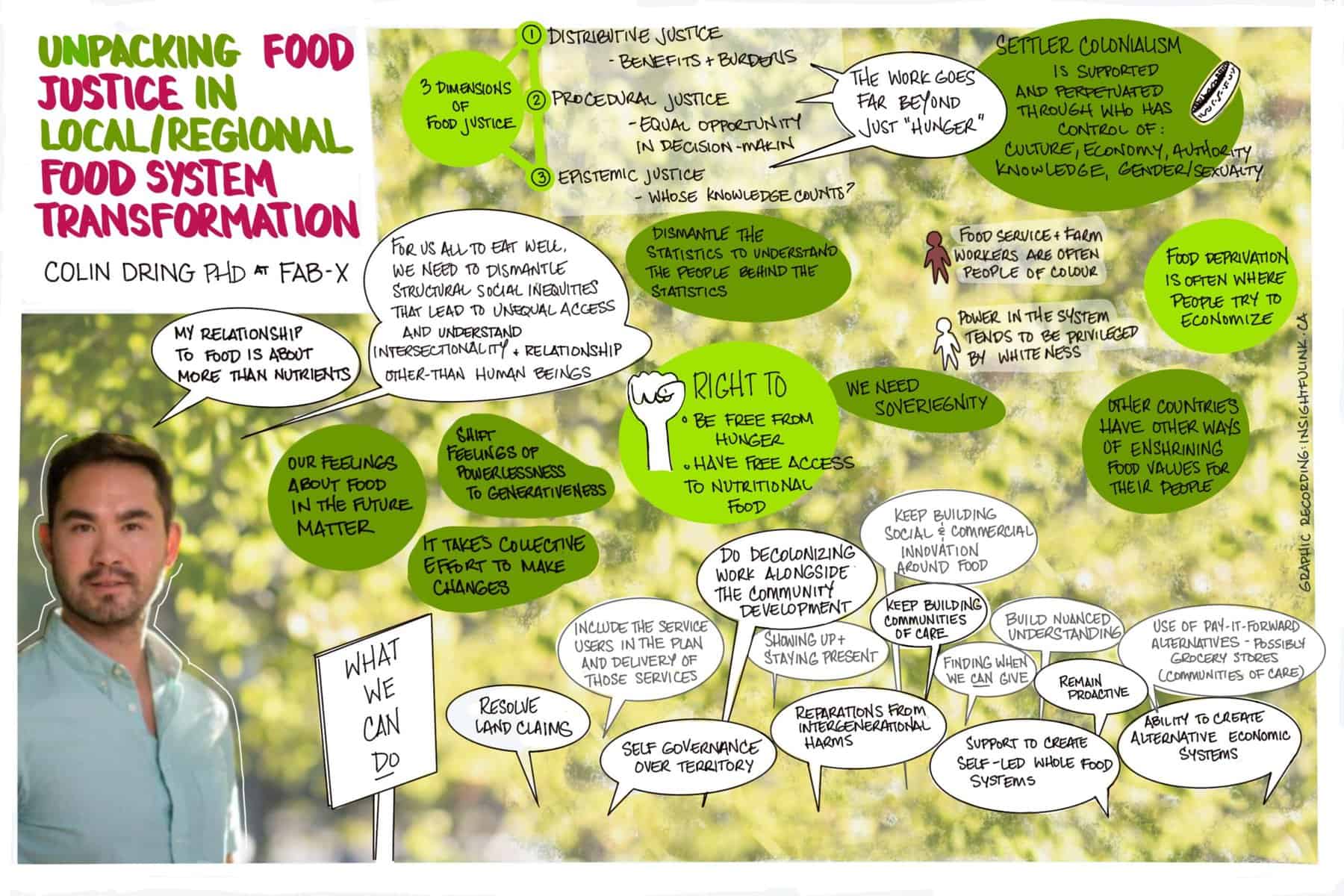
Dr. Colin Dring's talk, 'Exploring Food Justice Through Alternative Food Systems', was a cornerstone of our educational journey at FABx. His insights provided a deeper understanding of the challenges and opportunities within our food systems, emphasizing the need for justice and equity in food accessibility. The graphic created from his talk further illuminated these critical concepts.
The Power of Collaboration
This year's FABx was a testament to the power of collaboration. As CKFPC, we were thrilled to support and be part of this dynamic event. Our involvement in sponsoring the farm tour and Dr. Dring's talk showcased our commitment to educational and enriching experiences. The tour of Yaqan Nukiy Farms, enjoyed by council members, retailers, and chefs, was a perfect alignment with our goals of fostering understanding and support within our community's food systems.
We look forward to continuing these partnerships and bringing more impactful experiences to our community.
Links
Council Meeting & AGM - May 11, 2023
Our next Council meeting and our Annual General Meeting will be held in Nelson on May 11, 2023 from 10:00 - 1:30.
The Nelson Community Food Centre, one of our member organizations, is hosting the event. It will start off with a tour of their newly renovated space and a talk about their community food programming.
The gathering will also include our usual roundtable of member updates and a light lunch. Everyone is welcome to join us for the gathering, but rsvps are necessary. If you are interested, please contact Marya Skrypiczajko at ed@ckfoodpolicy.ca.
February 2023 Newsletter
Our winter newsletter is full of updates from Central Kootenay Food Policy Council members, details on Seedy Saturday and Sunday events in March, an introduction to the RDCK's Climate Action Plan and more. Click here to take a look.
Fall 2022 Newsletter
Check out the latest edition of our newsletter to learn about regional events, Clutch Farm in Salmo, staff changes at the Council, current grant opportunities and more.
Click here to sign up to get our e-newsletter delivered to your inbox.
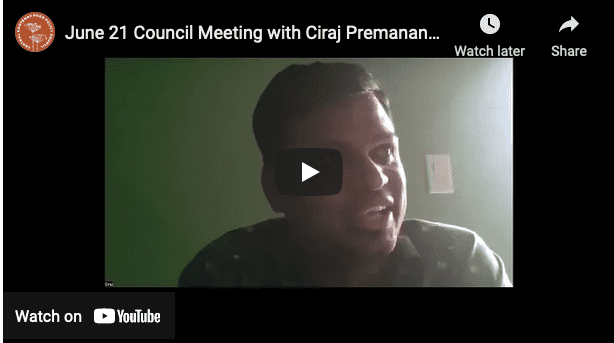
Watch: Ciraj Premanantham's talk at June Council Meeting
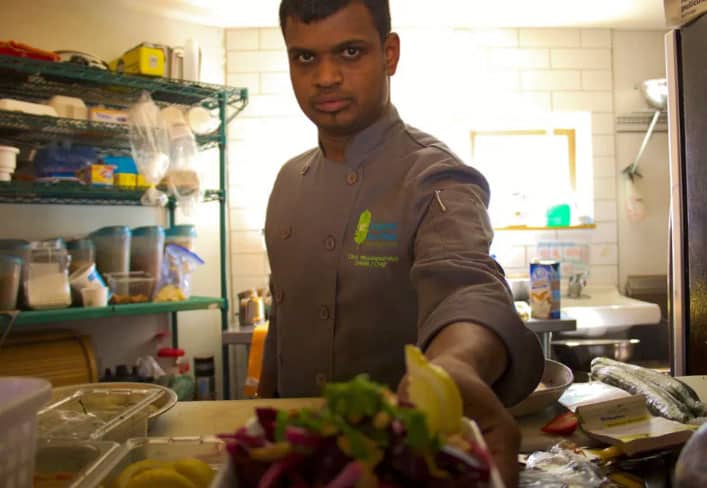
On Tuesday June 21st, 2022, chef and entrepreneur Ciraj Premanantham joined us for a Council meeting where he shared his personal journey of developing and running his flourishing food businesses in Nelson.
Ciraj is owner and operator of several businesses specializing in delicious South Indian food, including the Kootenay Tamil Kitchen, KTK Masala Shop and KTK Rosemont Market.
It was a lively and engaging session that left many participants inspired by Ciraj's hard work and his deep connection to the Nelson community.
You can watch the recording of the session here:
Join us for June 21 Council Meeting with Ciraj Premanantham
We are excited to have chef and entrepreneur Ciraj Premanantham join us for our next Council meeting where he will share his personal journey of developing and running his flourishing food businesses in Nelson. Ciraj is owner and operator of several businesses specializing in delicious South Indian food, including the Kootenay Tamil Kitchen, KTK Masala Shop and KTK Rosemont Market.
In addition to hearing from Ciraj, there will be time for regular Council meeting business, including updates from our members.
This meeting will be held online on Tuesday June 21st from 1:00pm to 2:30pm PDT and is open to Council members and anyone wishing to attend. If you are interested in joining us for the first time, please email comms[at]ckfoodpolicy.ca.
About Ciraj Premanantham
Ciraj is a Red Seal Chef and has been working in the food and beverage industry for over 18 years. He started his career in India with the Sheraton group of hotels and then worked for U.S Cruise lines where he was chef for over 6400 guests and managed 137 cooks. He moved to the Kootenays in 2012, working as a cook at the Prestige Inn Lakeside Resort and eventually becoming the owner-operator of the West Coast Grill in the Prestige Inn Lakeside Resort. In 2012, he started the Kootenay Tamil Kitchen out of a desire to offer authentic South Indian cuisine in the Kootenays. Along with his wife Martina, they have expanded their businesses to include the KTK Masala Shop, a grocery store offering authentic South-Indian spices and products, and KTK Rosemont Market.
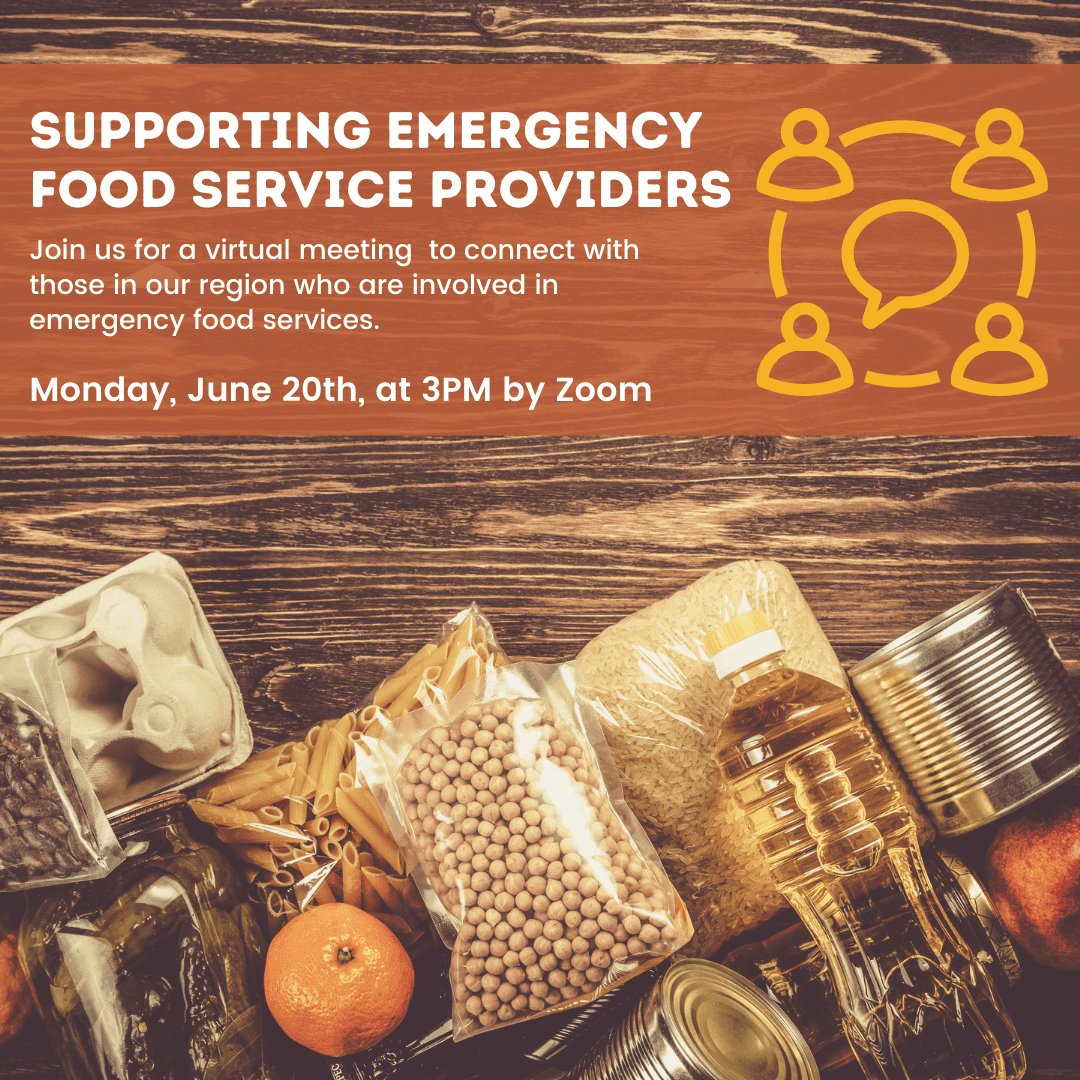
Supporting Emergency Food Service Providers
Please note: An earlier version of this post had the time listed as 3pm. The meeting will now be at 2pm.
We are strong believers, at the Food Policy Council, that great things can happen when we work together - or at the very least we can lighten the load when we work together. Emergency food services in many of the rural areas and small communities of our region rarely have the luxury of continuity - where the same individual is able to build relationships with both the sources of food and with those who will benefit from access to it. This points to a strong need to provide support that can bridge gaps between funding, staffing and service offerings.
The Central Kootenay Food Policy Council will be hosting a virtual meeting for all those in our region who are involved in emergency food services. Our intention for the meeting is simple: to enable people to connect with each other, to learn what is working and what the challenges are, and to brainstorm options for making it easier to ensure that our communities are well fed. The meeting will be Monday, June 20th, at 2PM by Zoom. Please mark your calendars and RSVP to ed@ckfoodpolicy.ca to receive the Zoom invitation.
Please share this information with anyone you know who provides emergency food services in the Central Kootenay.
Policy Morsels - May 2022 Newsletter
Check out the latest edition of Policy Morsels, our quarterly e-newsletter. The May 2022 edition includes an update on Council changes (including welcoming our new ED!), the latest in our Foodshed Fanfare series, funding opportunities, upcoming workshops and more!
Click here to sign up to get our e-newsletter delivered to your inbox.

Foodshed Fanfare - Hollie Wheeler & Sam Lazenby transition Nelson's Chocofellar

This is the third in our Foodshed Fanfare series, where we celebrate the many wonderful people who reside in the Central Kootenay and who quietly contribute so much to our region’s food systems.
Hollie Wheeler was the first person I met when I moved to Nelson 32 years ago, with a newborn and 2 year old in tow. She was standing behind a table of baby and toddler supplies at an event I found in the Pennywise. I cannot recall if I purchased any of Holly’s offerings but I do remember the connection we had, most likely based on a shared love of good food and the experience of early family life. I was delighted to learn that she and her partner, Sam Lazenby, were starting up a chocolate business a short walk away from my new home. I recall many a visit to the kitchen at the Anglican Church where Sam would be tending the magical machines that produce such yummy creations. Across the room, Hollie applied her design genius and artistic eye to developing beautiful packaging to transport the chocolates from their kitchen to our hands.
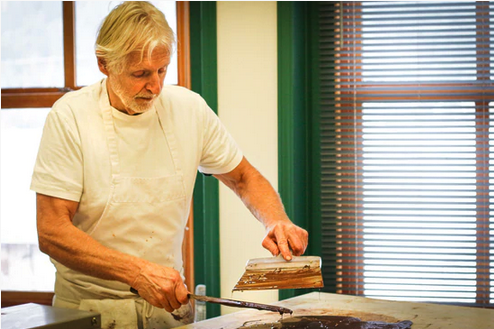
Over the years I had the privilege of watching their chocolate business grow, resulting in a move from the kitchen at the Church to their own dedicated chocolate kitchen. In addition to the considerable perk of becoming their unofficial taste tester, I gathered key lessons about surviving as a small food business in rural British Columbia. I learned about the challenges of transportation and distribution from Hollie and Sam. Getting chocolate from their kitchen to the many stores they served around our region in the high heat of summer entailed a lot of early morning trips and creative packaging to protect those precious morsels. I watched them have to rethink and re-calibrate their chocolate mixes as international chocolate suppliers changed their offerings, sometimes due to catastrophic losses for farmers and in ecosystems far across the planet. They always managed to adapt, achieving a consistent quality that has delighted so many for the last three decades.
At one point, Sam and Hollie were providing chocolates to high end hotels in the Lower Mainland, to adorn the pillows and delight the bellies of hotel guests. And their chocolate bars could be found in food outlets across the province. However, the pressure and labour of such a large service area undermined their family’s quality of life. To this day, I admire their courage and respect their decision to resist the business myth that bigger is always better and to scale back their market range to just the Kootenays. This gave them more time with their family and in the lake across from their home, enjoying the quality of life that is so abundant in our region if we are wise enough to prioritize it.
As with any farm or food business based in our region, I am always anxious until I learn that there has been a successful hand off of the enterprise. I am delighted that Hollie and Sam are transitioning into a much deserved retirement. Being the incredibly generous humans that they are, and from long personal experience, they supported the new owners of Nelson’s Chocofellar during the busy season for all chocolate businesses, with peaks at Christmas, Easter and Mother’s day. We are so lucky that Sam and Hollie chose to make this region their home and to create and steward one of our region’s iconic food businesses for so long. We wish them a long and glorious retirement!

The Courage to be Different
By Abra Brynne, Policy Director
It takes a lot of courage to be visibly different. Many of us who do not fit into the neat boxes of the norm choose to hide how we are different, unless we know for sure that in that particular time and place it is safe to be seen. And in our white-dominated communities, there are many who have no choice but to be seen - and yet we render them invisible in so many ways in our daily life.
In 2021, we added a tool to our Farm & Food Directory to enable Indigenous, Black, other People of Colour, Youth, and LGBTQ2S+ individuals to self-identity in our Directory. Our purpose was to enable those who so choose to promote their identity, with the hope that it would better enable people to proactively support their businesses.
It is often much safer to stay hidden than to declare that one is different. Nevertheless, services and proactive policy cannot be effectively developed for specific communities if they are not known. For the first time last year, Canada’s national census provided an opportunity for people to self-identify as transgender and non-binary. No other country in the world has taken that step yet. And those who chose to self-identify as transgender or non-binary in that census are now captured in our national statistics and will help decision makers to understand, embrace, and provide services for transgender people around us.
Like so many others who are impoverished and marginalized within our societies, transgender and non-binary people are at greater risk of food insecurity. The new data provided by Statistics Canada can help all of us to better understand and take action to support the food security and well-being of transgender and non-binary people in our communities.
The print version of our 2022 Farm & Food Directory has just been distributed to outlets across the Central Kootenay. So far, we have 4 BIPOC-owned and 3 youth-owned businesses self-identify in the Directory. We have not had any businesses self-identify as queer yet, but we are glad that we have this option available for them when they choose. In the meantime, you can use the Directory to seek out and support the many other wonderful local businesses that greatly contribute to our region’s food economy and culture.
Welcoming our new Executive Director
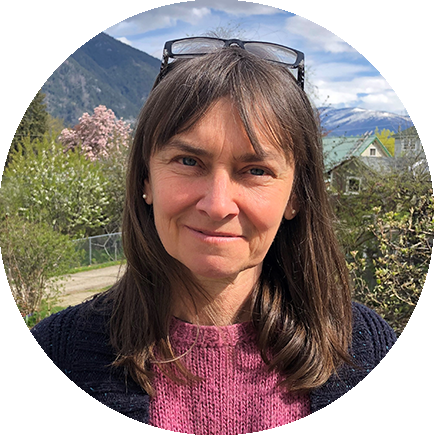
We are thrilled to announce our new Executive Director, Marya Skrypiczajko. Marya comes to the Council with a deep understanding of food systems in BC and locally.
For fourteen years she led the evolution of the Nelson Food Cupboard from a one program initiative to the Community Food Centre, with a host of programs serving residents in Nelson and area. “I am impressed by the breadth of resource development, networking, education and policy advocacy work accomplished by the Council and I am inspired by the serious commitment to moving forward on a path toward decolonization and reconciliation”, commented Marya.
The Food Policy Council team now expands to three people. After leading the Food Policy Council for 6 years, Abra Brynne has shifted into a newly created Policy Director role.
Annual General Meeting
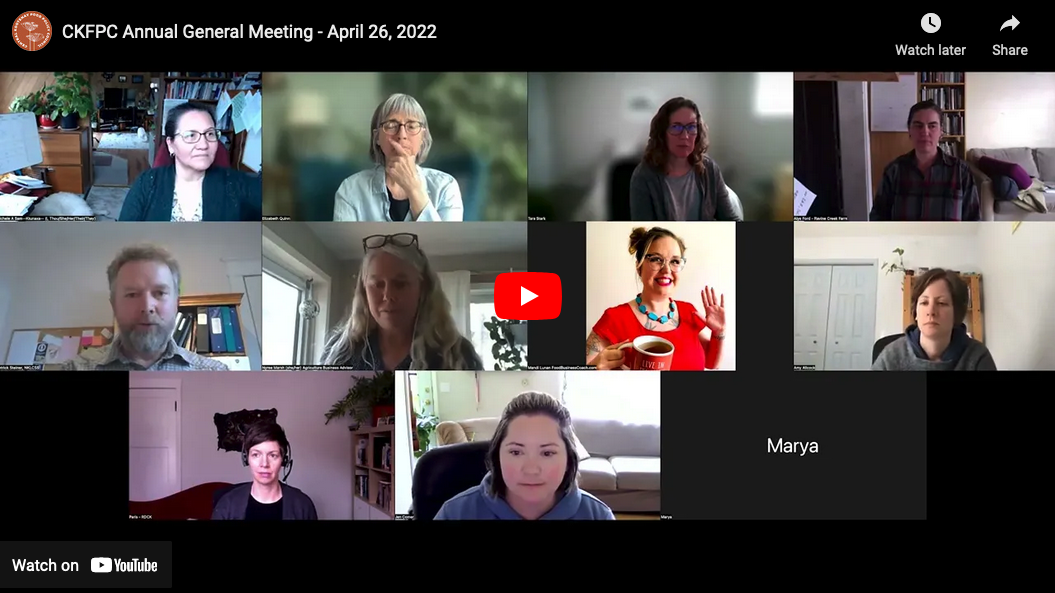
On April 26th, we hosted a special council AGM facilitated by Michele A Sam, who weaved together our regular AGM business with an interactive exploration of the principles of the Ktunaxa Creation Story. The session was a wonderful opportunity to explore some of the principles of the Ktunaxa Creation Story and how they can be applied to both the work of the Council and its members. Participants reflected on how they could bring what they learned into their work for the coming year. Many expressed gratitude for the gentle and refreshing format of the session and appreciated new ways of meeting and coming together.
You can watch the recording here:

Learning how to live in place
By Abra Brynne, Executive Director

On Sept 30th last year, our Council hosted Nasookin Joe Pierre, who enthralled us all with the Ktunaxa Creation Story. Not only is he a skilled storyteller, but the story itself drew us into the origins of this place we call home. Few of us can claim connections to the First Peoples of this place. But the Creation Story, nonetheless, contains profound lessons for us all, no matter where we originated.
Inspired by storytelling experiences at previous Council meetings and our anti-racism work, we are reimagining how to come together that is not so tied to white colonial practices. At our AGM on April 26, Ktunaxa ʔaqⱡsmaknik, Michele A Sam will lead us into a deeper exploration of the principles embedded in the Ktunaxa Creation Story. She will weave in the agenda items necessary for our Council, as a BC registered society. And she will help us to understand where our work can be deepened and linked to these landscapes where we live and work. By better understanding how the Ktunaxa Creation Story principles are reflected in this place, we have an opportunity to advance along a journey that allows us to be in right relationship with this place and its First Peoples.
At the Food Policy Council, we often talk about “place-based food systems”. We seek to highlight that food is not disembodied - it comes from a place, is the fruit of the earth, the water, the air, and the people who tend and harvest it. But it is also about embracing the people, ecosystems and cultures of that place. For those of us living in the Central Kootenay , the Ktunaxa Creation Story is but one of many stories that will enable us to embrace and understand more deeply this place, our shared space.
Please join us at our Annual General Meeting on April 26th from 1 - 3:30PM Pacific / 2 - 4:30PM Mountain. We can promise that it will engage you in ways not commonly found at AGMs.
2021 Annual Review

Check out our hot-off-the-virtual-press 2021 Annual Review and read about all of the amazing work we’ve been able to do over the past year in collaboration with our partners and with support from our generous funders.
Despite the challenges of pandemic, like many other organizations we were able to respond to increased demands on our time and contribute our part to supporting food resiliency and food security in the Central Kootenay region and elsewhere.
We’re so grateful for our Council members, supporters, funders and partners who enabled us to achieve what we did.
Call for new Council Members
Joins us as we work together to solve policy challenges

Are you involved in emergency food services? Are you a chef or food retailer? Do you raise meat? How about cannabis?
If you said yes, you will know that you are doing business in three of the most heavily regulated sectors in the agriculture / food world. And you will know that just because you solved your current challenge with policy does not mean that another one will not crop up next month, next year, some time….
The Food Policy Council loves to problem solve when it comes to policy. We are enthusiastic about figuring out how to make it all work better, to achieve our vision of a healthy, resilient, just regional food system. We want to connect with you and learn from you. Consider joining our Council. We won’t ask much – just that you bring yourself, your experience and your ideas to the five meetings we hold each year.
If you want to learn more, please check out our website, social media links, or contact Abra: info[at]ckfoodpolicy.ca. If you’d like to learn more about what we’re about, consider joining us for our AGM on April 26th, 2022.
Explore the Principles of the Ktunaxa Creation Story + AGM April 26th
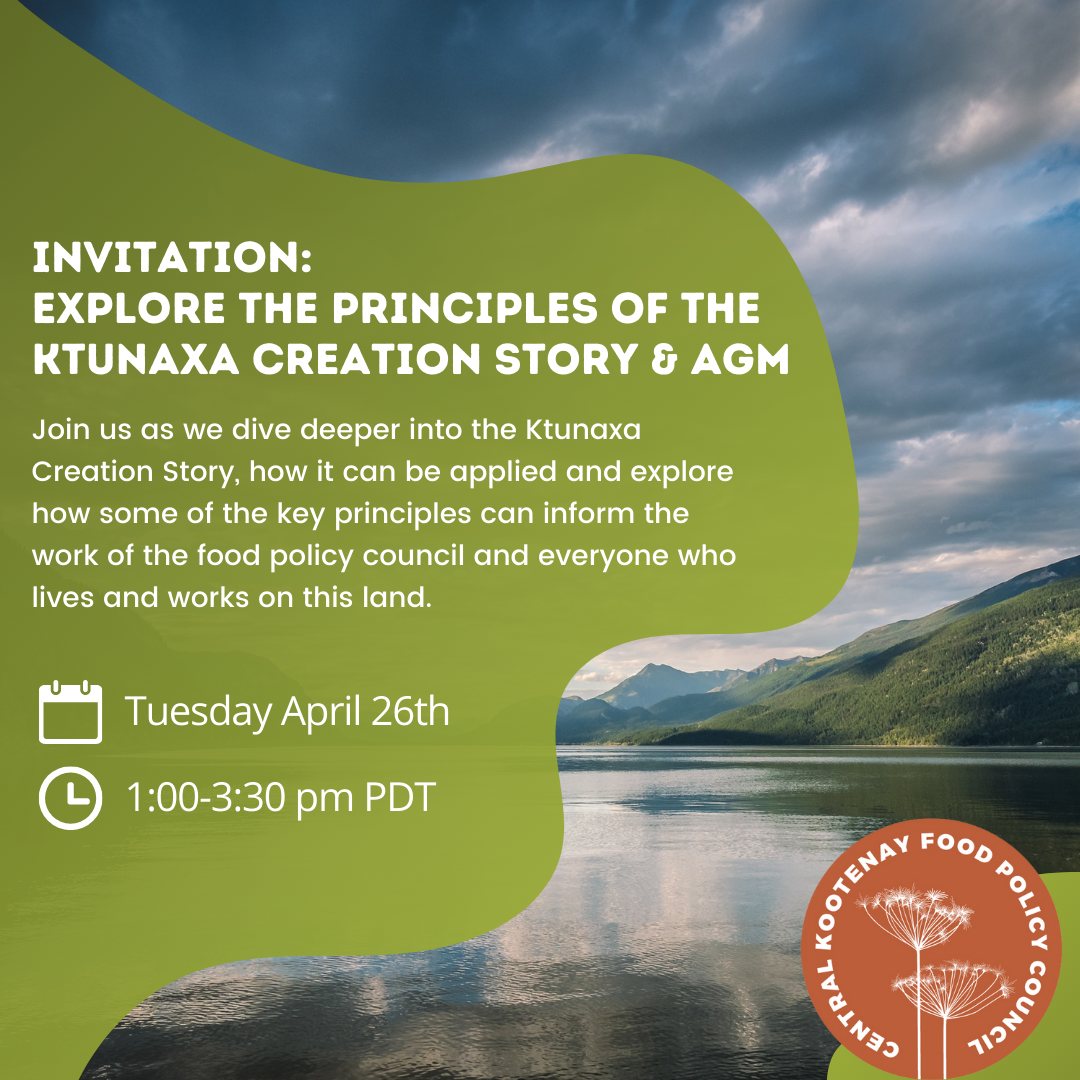
We invite you to join us for a special meeting where we will weave together an interactive exploration of the principles of the Ktunaxa Creation Story with our regular AGM business. This meeting will be held on Tuesday April 26th from 1-3:30pm PDT. Please note that this is longer than previously scheduled.

We are excited to have Michele A Sam join us once again to facilitate this session. Inspired by our experience of the Ktunaxa Creation Story with Nasuʔkin (Chief) Joe Pierre and the reflection and visioning sessions facilitated by Michele, we are going to dive deeper into the Ktunaxa Creation Story, how it can be applied and explore how some of the key principles can inform the work of the food policy council and everyone who lives and works on this land.
This meeting is open to Council members and anyone wishing to attend. If you are interested in joining us for the first time, please email comms@ckfoodpolicy.ca.
This session will build upon the Ktunaxa Creation Story with Nasuʔkin (Chief) Joe Pierre , so we strongly encourage anyone who wishes to attend the session to watch the recording beforehand. Alternatively, you can read this transcript of Nasuʔkin (Chief) Joe Pierre telling the Ktunaxa Creation Story to school children and educators in SD 79. Please note that the video and transcript are slightly different due to the practice of context-specific storytelling.
Meeting Materials
- Agenda
- Financials - Income Statement and Balance Sheet
- Minutes from 2021 AGM
- 2021 Annual Review
Zoom Details
Zoom link:
https://us02web.zoom.us/j/89714866220?pwd=K2VvVjJrYmk5UVhuRzZsekttelJYQT09
Meeting ID: 897 1486 6220
Passcode: 008666
One tap mobile:
+12042727920,,89714866220#,,,,*008666# Canada
+14388097799,,89714866220#,,,,*008666# Canada
Dial by your location:
+1 778 907 2071 Canada
+1 780 666 0144 Canada
Meeting ID: 897 1486 6220
Passcode: 008666
Black History Month & Food Justice
By Abra Brynne, Executive Director
I have been writing about place-based food systems for some time now, using those terms to draw attention to myriad facets of foodsheds, watersheds, ecosystems, people, place and culture, to name a few.
I grew up in a place a few mountain chains west of here. I have lived in this region for 32 years, I feel deeply rooted here and wish to live out my days in this place. I can only imagine how much deeper that connection to the mountain, valleys, rivers, and lakes must be for the people who are indigenous to this region, the Ktunaxa, Sinixt, Syilx, and Secwepemc.
As for the rest of us, we come from away, as they say in the maritimes. There are new immigrants among us, but for most families, if we trace our family history back a few generations, it becomes clear that we came not just from "away" but from across the oceans to land on Turtle Island. My own family, as Mennonites, came to this continent fleeing religious persecution. But they still had a choice.
The vast majority of black people residing on Turtle Island are descendents of people who had no choice. The conditions on the ships for impoverished immigrants were absolute luxury compared to those endured by the millions of Africans stolen and sold into slavery. If you have never seen the diagrams depicting how to stack human black bodies like firewood or potatoes in the bowels of the ships, they are truly appalling. Many did not survive the torture of those long journeys across the Atlantic Ocean. And life off the ships, for most, was not much better.
As Canadians, we tend to cloak ourselves in myths about the lack of racism and slavery in our country, contrasting ourselves with our American counterparts. Yet “slavery existed in Canada from the 16th century until its abolition in 1834. After slavery was abolished, African Canadians still had to contend with de facto segregation in housing, schooling and employment, and exclusion from public places such as theatres and restaurants.” 1 In Canada many monuments, universities, and other public memorials, bear the names of slave owners. We do not recognize this because the history and contributions of Black People across Canada have been deliberately eradicated. The only known cemetery in Canada for Black slaves is virtually unknown in the broader public. It is located south of Montreal and bears a terrible, racist name - no bronze statue for them.
As the Working Group of Experts on People of African Descent reported from its mission to our country, “Canada’s history of enslavement, racial segregation and marginalization has had a deleterious impact on people of African descent, which must be addressed in partnership with communities. Across the country, many people of African descent continue to live in poverty and poor health, have low educational attainment and are overrepresented in the criminal justice system. It is important to underline that the experience of African Canadians is unique because of the particular history of anti-Black racism in Canada, which is traceable to slavery and its legacy, through specific laws and practices enforcing segregation in education, residential accommodation, employment and other economic opportunities. History informs anti-Black racism and racial stereotypes that are so deeply entrenched in institutions, policies and practices, that its institutional and systemic forms are either functionally normalized or rendered invisible, especially to the dominant group.” 2
How deeply entrenched anti-Black racism is in our country is demonstrated, in part, by the fact that “the greatest determinant of household food insecurity for Black people is simply being racialized as Black, resulting in Black household being 3.56 times more likely to be food insecure than their White counterparts." 3 (emphasis added)
When People of Colour speak of oppression and harm, all too often the response from white people is to speak of our own. This is akin to telling someone who has just broken their leg and is in urgent need of medical attention that you have a scratch on your hand and need a band aid. As white people on Turtle Island we have to truly commit to getting out of the centre, the spotlight. The world does not have to function only and always in reference to us. One way we can decentre ourselves is through education - listening, learning about history, and speaking to oppression when we see it.
At the Food Policy Council, we continue to work on our own learning and to transform our organization to better incorporate and prioritize a food justice lens that recognizes the historical and ongoing harm of systemic racism as it is manifested in food systems. Among our current actions, our Anti-Racism Working Group meets monthly and we are actively fundraising so that we can hire a dedicated Anti-Racism and Justice Coordinator. We believe that, as Reni Eddo-Lodge has stated, “Every voice raised against racism chips away at its power. We can’t afford to stay silent.” 4
Resources:
There are a host of great resources to support learning about and action against systemic racism. Here are but a few:
- Intercultural Kootenays aims to help build and maintain inclusive and non-discriminatory communities in the Kootenays
- We are STORYFOLK by Shayna Jones, who performs African and African Diasporic Folklore and leads The Black & Rural Project, connecting rural black dwellers across Canada
- Dismantling Racism in the Food Systems, by Food First.
- Food Justice, by Toronto Food Share. Scroll to the bottom for their action plan on combating Anti-Black Racism.
- Anti-Racism in Farming, a program of the Ecological Farmers Association of Ontario which includes a dedicated Equity & Organizational Change Manager position.
- 21-Day Racial Equity Habit Building Challenge, run by Food Solutions New England
- Hope Meets Action, a virtual interactive exhibit that is a partnership between the BC Black History Awareness Society and the Royal BC Museum
- Canada Race Relations Foundation
Footnotes
- Report of the Working Group of Experts on People of African Descent on its mission to Canada, page 4.
- Ibid. page 7.
- Dismantling Racism in Canada’s Food Systems, by Dr. Katherine Lyon, page 4.
- Reni Eddo-Lodge, Why I’m No Longer Talking To White People About Race, page xxi.
Council Vision Session
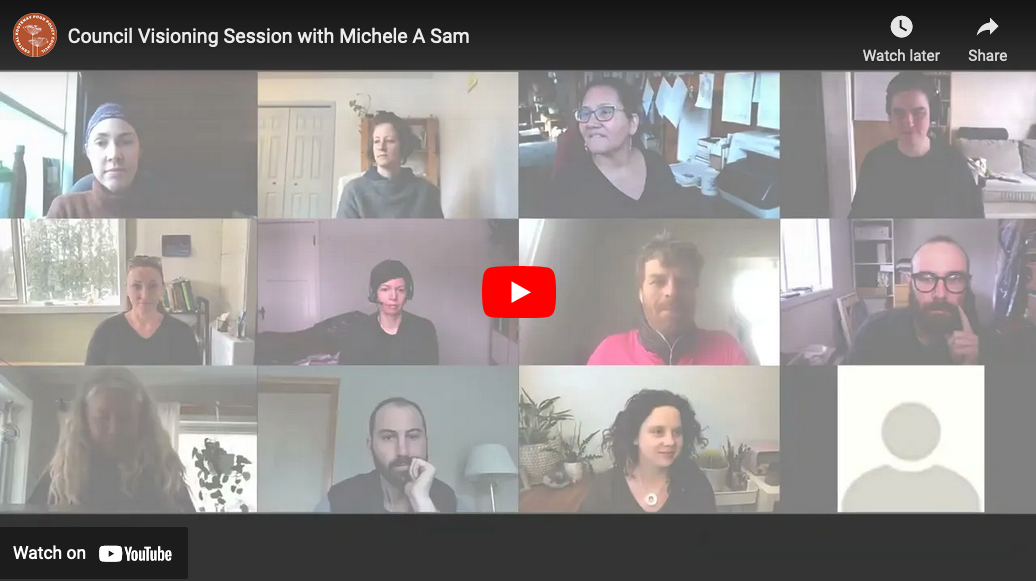
On Thursday February 10th, 2022, we hosted a special Council vision session facilitated by Michele A Sam. This session built upon the November 25th Reflection session and was a dynamic and thought-provoking exploration of the future vision and mission of the Council.
This session was a wonderful opportunity to pause and reflect on where we are at now and where we want to go, which seems especially timely given all of the pressures on our food systems and on us as communities. It was also helpful to reflect on justice and reconciliation and how we can transform the Council to more fully integrate all the dimensions of justice into our work.
You can watch the recording of the session here:
Session Resources:
We are excited about what lies ahead for the Food Policy Council and how we can continue to evolve and transform the organization to better reflect our commitment to just food and to improving the resilience of our region's food systems.
Council Reflection Session
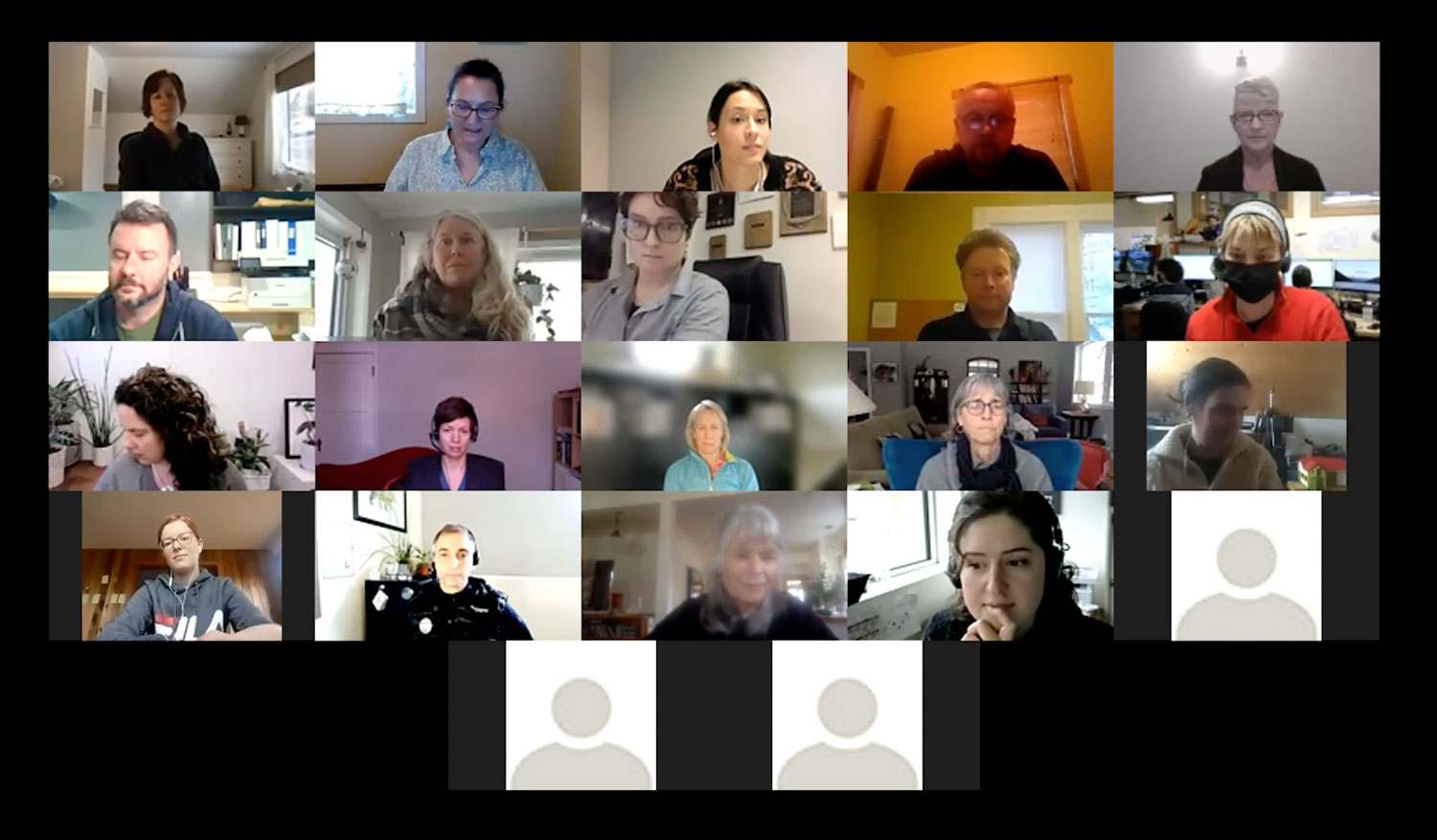
On Thursday November 25, 2021, we hosted a special Council reflection session facilitated by Michele A Sam. It was a rich learning experience and discussion that celebrated the work the Council has done over the past five years while also providing a new perspective on the work that needs to be done moving forward.
You can watch the recording of the session here:
Session Resources:
- Michele’s slides (PDF)
- Michele’s Paper: Contextualizing Approaches to Indigenous Peoples’ Experiences of Intractable Conflict
- Michele’s Podcast: Ktunaxa Her Stories -- Living Life, Well and Long
- Books
- You Are What Your Grandparents Ate: What You Need to Know About Nutrition, Experience, Epigenetics and the Origins of Chronic Disease by Judith Finlayson
- Making Native Space: Colonialism, Resistance, and Reserves in British Columbia by R. Cole Harris
- Enough to Keep Them Alive: Indian Welfare in Canada, 1873-1965 by Hugh Shewell
We will be holding another session with Michele in the new year. Please mark your calendars for Thursday January 13th from 10am-12noon PST with more details to follow. This session will build upon the reflections and ideas presented in the first session, so we strongly encourage anyone who wishes to attend the second session to watch the recording. If you are interested in attending our next session, please RVSP to comms[at]ckfoodpolicy.ca.
Support our Council Members on Giving Tuesday

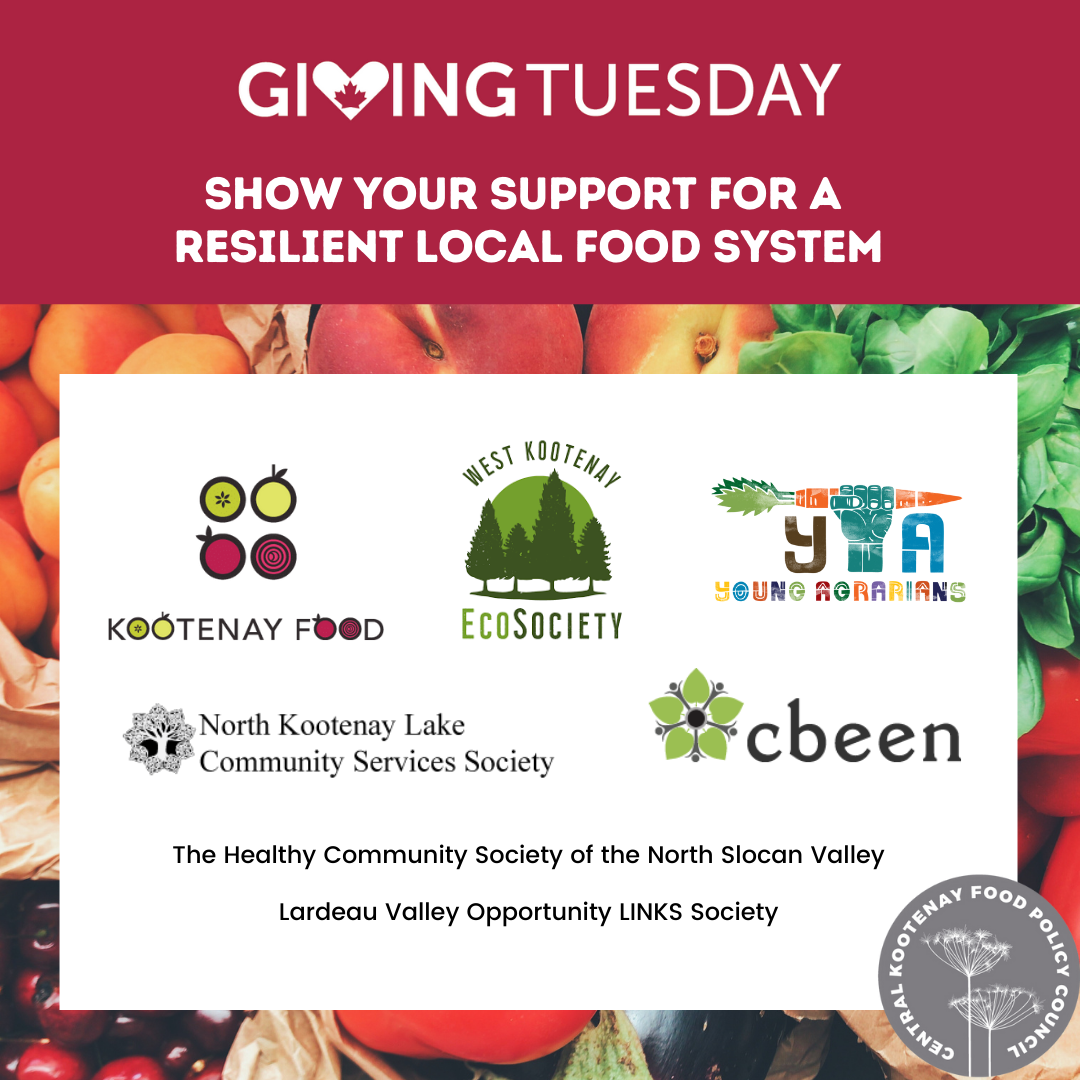
Giving Tuesday is a global generosity movement and a great opportunity to show your support for local causes.
Many of our Council members are involved with organizations who are working hard to ensure that the food system in the Central Kootenay region is robust, thriving and accessible.
If you are participating in Giving Tuesday this year, please consider showing your support by donating to one of our Council Member organizations.
You can donate online to the following:
- North Kootenay Lake Community Services Society
- Young Agrarians
- West Kootenay EcoSociety
- Columbia Basin Environmental Educators Network
Other organizations in need of support are: Healthy Community Society of the North Slocan Valley, Lardeau Valley Opportunity LINKS Society, and the West Kootenay Permaculture Coop. Please contact these organizations directly to find out how to best support their work.
Foodshed Fanfare - Dave Johnson of West Arm Apiaries
This is the second in our Foodshed Fanfare series, where we celebrate the many wonderful people who reside in the Central Kootenay and who quietly contribute so much to our region’s food systems.
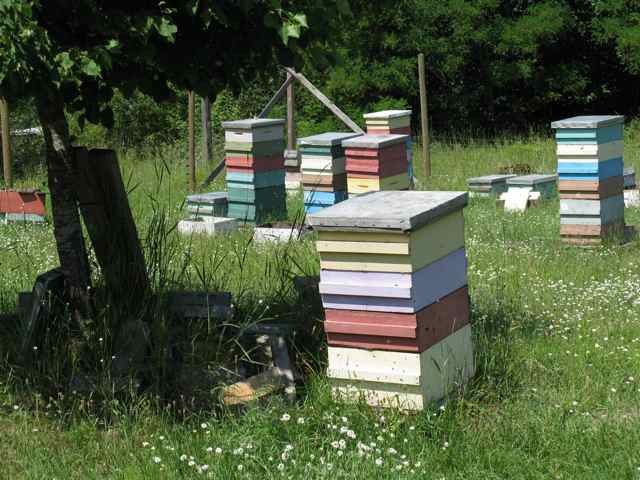
Just like the bees that he has tended his entire adult life, Dave Johnson's impact on our region's food systems is quiet but widespread. Dave is the owner of West Arm Apiaries. His beekeeping adventures began decades ago, when his father arrived on his newly purchased property with a set of hives that were being moved to protect the children in their former location, who were getting a bit too close for comfort on both sides.
Over the intervening years, Dave clearly honed his skills to such a degree that he became an acknowledged leader and mentor in the local beekeeping community. When Kootenay Local Agricultural Society ran a series on beekeeping for beginners, Dave was the obvious choice to lead the newbies into the adventures with honey bees. He has provided binders of information, farm tours, and ad hoc advice to a host of fledgling and experienced beekeepers.
Some Council members will recall the tour we received at West Arm Apiaries in September 2018. We squeezed ourselves into a small building and learned about the intricacies of extracting honey from the hives. Dave's deep commitment to the wellbeing of his livestock (bees), his knowledge of them, and the marvelous honey that they co-produce was all on ready display.
Dave and his wife Pat have also raised sweet corn, garlic, and blueberries that have always been in high demand - at the farm gate. In addition to being the nursery for local beekeepers, bringing in nukes that are the foundation of new hives, they have also run a blueberry nursery, farming out bushes to area backyard gardeners and farmers. If you want to read more and connect with Dave, check out his listing in our Directory.
In this Foodshed Fanfare, we honour Dave's long commitment to healthy ecosystems, healthy bees, and to sharing knowledge born of decades of dedication and hard work.
Reflections on September 30th & Ktunaxa Creation Story
Our September 30th Council meeting was scheduled long before the National Day for Truth & Reconciliation was announced. We were fortunate to have secured an agreement from Nasuʔkin (Chief) Joe Pierre to share with us the Ktunaxa Creation Story.
He began by telling us about his elders and those from whom he had learned this foundational story of the Ktunaxa people. Despite the harsh actions of those who ran the Residential Institution in the Ktunaxa territory and other colonial actions that have sought to destroy their culture, the story has been maintained and passed on through countless generations.
You can watch the recording here and read on below for some reflections on the experience.
As Nasuʔkin (Chief) Joe Pierre reminded us, Truth will not be achieved unless and until Recognition is achieved for all the Nations that exist across Turtle Island, honouring their cultures, their Territories, celebrating their languages and enabling the flourishing of their communities and peoples.
For those of us who are settlers in this region, it was an incredible opportunity to see the landscape and its inhabitants in a new light and with a new / ancient language. It was evident from the faces on the Zoom screen that people were deeply engaged in the story. We were happy to share the event with staff and elected officials from the RDCK, as well as others in the region who chose to spend the morning of the first National Day of Truth & Reconciliation with a Ktunaxa Elder.
Afterwards, participants shared their reflections. For many, it was a spiritual and emotional experience. The absence of similar learning opportunities in the curriculum of our schools, past and present, was identified as a loss and problem. There was widespread gratitude and wonder in the Ktunaxa place and animal names that we learned together in a language that is unique on Turtle Island, based in the vibrations and long history of this place.
Nasuʔkin (Chief) Joe Pierre closed by quoting Senator Murray Sinclair, who led the Truth and Reconciliation Commission for 6 years. Truth and Reconciliation will be achieved, in part, by creating relationships of mutual respect. We were invited to share the story, as long as we, like him, honour our sources.
Exploring Food Systems Through the Arts

Drawing inspiration from our work in 2020 with artist, Mercedes Minck, we are excited to launch our Exploring Food Systems Through the Arts program.
We have secured a generous grant from the Kootenay Coop, who are challenging other area funders to match their $2500. With the funds raised, we will hire local artists - in any medium - to create unique works of art that explore various themes related to food systems and food policy. We will launch the program once we have hit our initial goal of $10,000.
The artists will comprise a group of 8-10 artists from various disciplines (Literary, Dance, Media Arts, Music, Theatre, Visual Arts) who live and work in the Central Kootenay region. They will be a mix of emerging and established artists and will reflect the diversity of the Central Kootenay region, and will include Indigenous artists, artists of colour, artists with diverse abilities, non-binary artists and 2SLGBTQ+ artists. We shall be integrating this partnership with local artists as part of our ongoing Food Systems Literacy Program. We recognize that important contribution that the arts bring to education, to celebration, to culture, and to our local community.
If you are an artist and we have tweaked your interest, please reach out to Amy (comms@ckfoodpolicy.ca) to learn more. If you are an interested funder, please contact Abra (info@ckfoodpolicy.ca).
Policy Morsels - October 2021 Newsletter
Check out the latest edition of Policy Morsels, our quarterly e-newsletter with updates on our activities, events, and the latest policy happenings.
Click here to sign up to get our e-newsletter delivered to your inbox.

Balancing Forest Values: Water Security
The first post in a series of outlining the values that underpin our Balancing Forest Values law reform project.
By Abra Brynne
Twenty eight years ago when I drove into Ymir to meet my new father-in-law, I was startled to see a sign attached to the carport that proudly read "This family is supported by timber dollars” - and it was not the only one in that small village. Over time, my father-in-law expressed disgust at the changing logging practices and the impact he saw across a landscape that he loved and spent endless hours in, working and playing.
Since 2017, the residents of the Village of Ymir have been “under threat of losing our water and our town from industrialization in our watershed forest.” There is widespread concern amongst Ymir residents that if any industrial activities take place in their watershed, their only water source will be lost – water for drinking and for fighting fires. A community with no water source becomes a ghost town. The incalculable loss that hangs over the community includes investment in homes and properties, in businesses, cultural institutions, and the strong social cohesion that is typical of rural villages. Ymir is but one community amongst many whose residents log thousands of volunteer hours as water stewards, at a cost to their careers and families.
Despite the fact that there is legislation in place to protect drinking water, the full force of the protections has never been enacted. In the Forest and Ranges Practices, Water Sustainability, and Land Acts and their associated legislation, logging is always privileged. The same laws that privilege logging over water protection, recreation and ecosystems resilience also impede progress on upholding the rights and title of Indigenous people whose Nations predate British Columbia.
The community of Ymir and their effort to protect their watershed is one of the inspirations for our Forest Values project. This new project seeks to bring a more balanced approach to forest management in BC. The project goal is to create the necessary social and political will to successfully change laws in BC that privilege resource extraction over other values and services provided by our forests and lands. While the value of economic activity derived from BC’s lands and waters is undeniable, other values include full recognition of Indigenous rights and title, recreation and tourism, safe and adequate drinking water, and healthy river and riparian ecosystems that support diverse species. This project will forefront water as the rationale for law reform, as it is central to all life, resilient ecosystems and our food systems. If you are interested in learning more about this project, please reach out to our Executive Director (info@ckfoodpolicy.ca).

Acknowledging the first annual Truth & Reconciliation Day

Across Canada, on the first National Day for Truth and Reconciliation, people will have a chance to stop and reflect. This National Day was established six years after the Truth and Reconciliation Commission of Canada issued 94 Calls to Action. Number 80 calls “upon the federal government, in collaboration with Aboriginal peoples, to establish, as a statutory holiday, a National Day for Truth and Reconciliation to honour Survivors, their families, and communities, and ensure that public commemoration of the history and legacy of residential schools remains a vital component of the reconciliation process.” (Final Report of the Truth and Reconciliation Commission of Canada, Volume 1: Summary, page 334). The subtitle of the Volume is “Honouring the Truth, Reconciling for the Future”.
The citizens and institutions of Canada have a wide range of understanding and recognition of what it means to be a colonizing country - historically and currently. September 30th seeks to deepen Canadians’ understanding of what it has meant for far too many Indigenous families to have to live with having their children taken away, often brutalized, and stripped of their language and culture. The impact on those individual children and on their families and communities is profound and horrific.
The Calls to Action includes 93 other actions that address the myriad steps that need to be taken to both confront the truth of Canada as a colonizing country, and to address the wrongs. Land is at the centre of many of those wrongs. Here in British Columbia, most of the land was never ceded. To confront the truth of that is to recognize that our fee simple approach to land ownership is contrary, at best, to the governance structures of the people who have lived here and stewarded the lands and waters since time immemorial.
The Food Policy Council scheduled a meeting for September 30th, long before it was announced as a National Day. We encourage everyone to take time on that day to read and reflect on the Calls to Action of the Commission. And we also invite you to join our meeting and come on a wondrous journey with us as we listen to Nasookin Joe Pierre tell the Ktunaxa Creation Story, grounding us in the land and waters of the region in which we are so privileged to live.

Join us for our next Council Meeting featuring the Ktunaxa Creation Story
We are excited and honoured to have Nasuʔkin (Chief) Joe Pierre join us for our next Council meeting where he will share the ʔaq̓am version of the Ktunaxa Creation Story. Joe Pierre is a gifted storyteller who recounts the history of the Ktunaxa people and this land with depth and dynamism.
This meeting will be held online on Thursday September 30th from 9:30am to noon PDT and is open to Council members and anyone wishing to attend. If you are interested in joining us for the first time, please email comms@ckfoodpolicy.ca.
We hope that you will join us for this opportunity to hear this story on September 30th, which is also the first annual National Day for Truth and Reconciliation. We believe that listening to this wonderful story will ground us thoroughly in this place where we work, live, eat, and play.
Zoom Details
Zoom Link:
https://us02web.zoom.us/j/86070776576?pwd=OFVEaEhGOVk1SFpORzgrSWMvaUNFQT09
Meeting ID: 860 7077 6576
Passcode: 807341
One tap mobile
+16475580588,,86070776576#,,,,*807341# Canada
+17789072071,,86070776576#,,,,*807341# Canada
Dial by your location - Find your local number: https://us02web.zoom.us/u/kd3746G67G
Meeting Materials
- Agenda (PDF)
- Staff Reports - Executive Director & Engagement Co-coordinator (PDFs)
- Minutes from July 29th Council Meeting (PDF)
About Joe Pierre

Joe Pierre was raised in the Community of ʔaqʾam formerly known as the St. Mary’s Indian Reserve and is a citizen of the Ktunaxa Nation. He attended the University of Calgary in the Fine Arts. At the U of C Joe met several other First Nations people interested in Theatre and they collaborated to form the Crazy Horse Theatre Company. The company mounted several productions in Calgary all of which were written by Aboriginal writers. Joe also worked for a season with the CBC production “North of Sixty”. Joe was a storyteller at the very first Proctor Storytelling Festival and he has presented at several other festivals throughout the Kootenays. Currently he is employed by School District 5 Southeast Kootenay and is a member of the Board of Directors for the First Nations Education Steering Committee. Joe served as a Councilor for the St. Mary’s Indian band for 8 years and was a member of the Board of Governors for the College of the Rockies for 6 years. In the Fall of 2016 Joe was elected back to the ʔaqʾam (formerly the St. Mary’s Indian band) council, this time in the capacity of Chief Councilor. And in February of 2021 Joe was reelected to a second term as Chief. He is a husband to wife Jennifer and a father to fifteen-year-old Jude. Together they are known as “Triple J”.
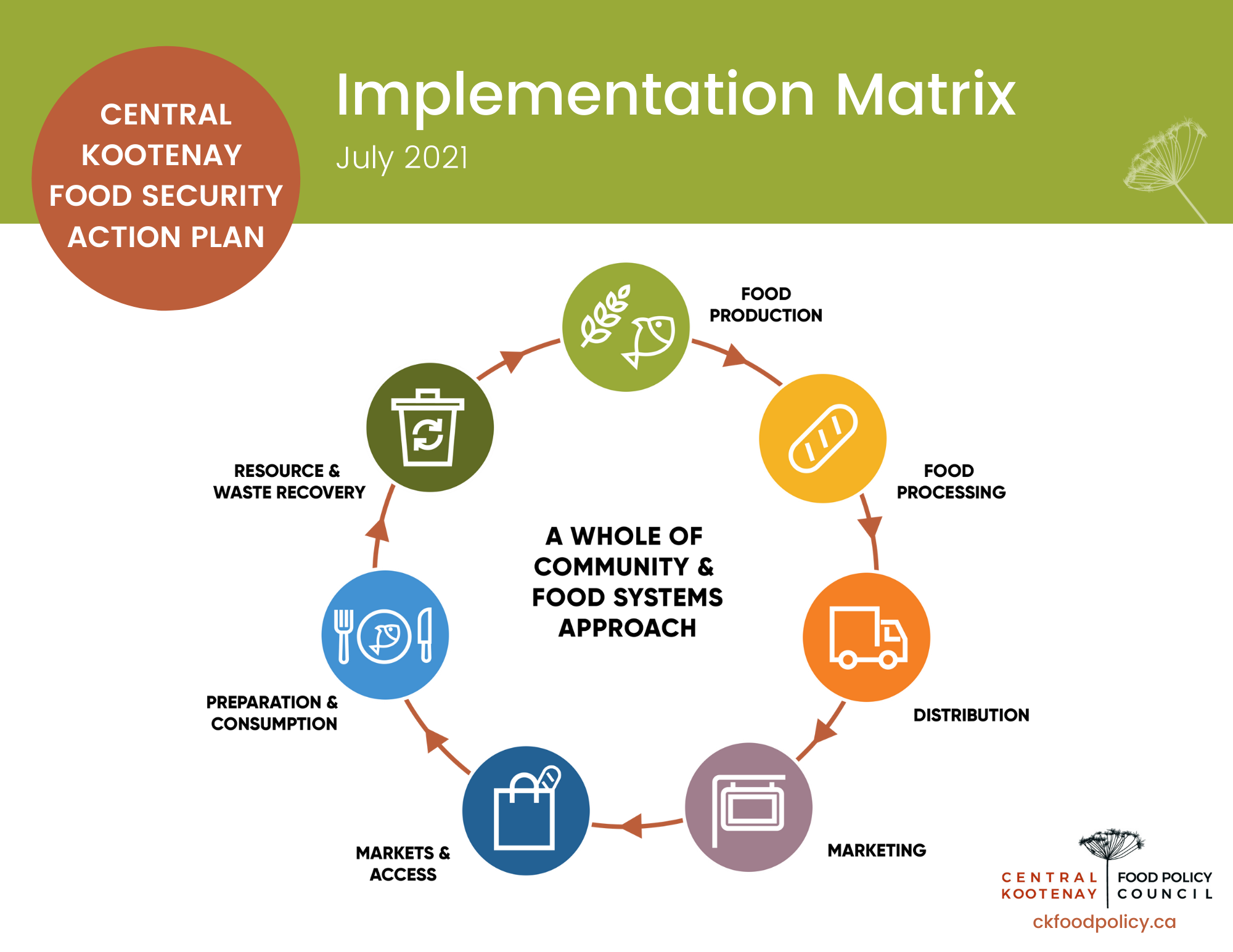
Implementation Plan for Food Security Action Plan now available!

It takes a village to raise a child and it takes a whole region (and more!) to create a resilient, abundant foodshed.
The Council was honoured to be asked by the RDCK to create a Food Security Action Plan for the region, in response to the impacts of the COVID-19 pandemic on our food security as a region and in our households.
The Action Plan includes an Implementation Plan that identifies the many actors and actions that need to be galvanized in order to achieve the vision of a food-secure Central Kootenay.
Check out the Implementation Plan (PDF) and see what actions you can be a part of moving forward.
Foodshed Fanfare - Karma Halleran of KS Perry Publishing
The Foodshed Fanfare series celebrates the many wonderful people who reside in the Central Kootenay and who quietly contribute so much to our region’s food systems.
We are pleased to feature Karma Halleran of KS Perry Publishing in our inaugural Foodshed Fanfare. Karma and her staff are the gifted crew behind many of our local prized publications, including the Pennywise, Go & Do, and our very own Farm & Food Directory.

In 2017, the Council approached Karma about partnering with us to create a self-funded regional farm and food directory. The enthusiastic and generous response was heartwarming, to say the least. Longtime Council members will remember the meeting in Silverton in November 2017 when we undertook a design process with Karma and her staff member, Rick, to collectively figure out what we wanted the look and feel of the Directory to be. Karma came with decades of experience and some great models and ideas. She and Rick listened carefully and well to the direction from Council members. The first Farm & Food Directory received rave reviews, as has each subsequent edition. The fourth edition of our Directory is currently in distribution across the Central Kootenay and beyond. Thanks to the genius of another key collaborator and Council member, Shauna Fidler, we again have a beautiful and eye-catching cover that will draw locals to discover the abundance of food providers captured inside.
The Directory provides a free platform for area farmers and food producers to let others know about their food and how to get it. The stories behind our food help us to have a deeper appreciation for those whose hard work brought us that food. The story behind the Directory you may soon be holding in your hands will hopefully inspire greater appreciation for those who work so hard to get information in front of our eyes. Without the generous and professional contributions of Karma and her team, we would not have such a great tool for understanding and celebrating our foodshed. Thank you, Karma!!
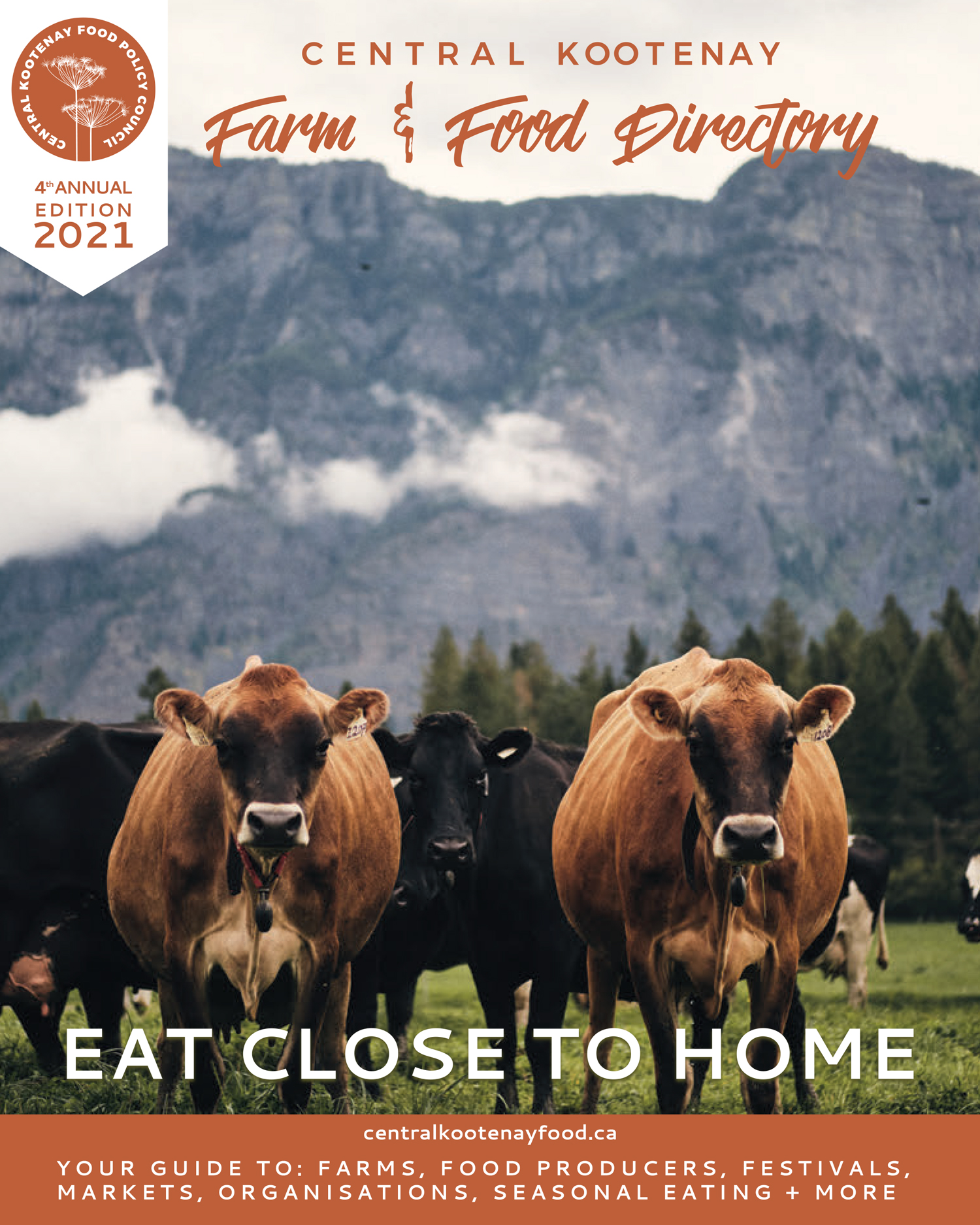
Print version of Farm & Food Directory available at a location near you!

Hot off the presses! The print edition of 2021 Farm & Food Directory is available for pickup.This free guide to eating locally is brought to you by the Central Kootenay Food Policy Council.
The guide has everything you need to shop and eat locally, with information about farms, food producers, markets, seasonal eating and more! If you are a farmer or food entrepreneur, the guide will help you to assess business opportunities, access ingredients, and reach new audiences. And if you are in local government, the guide helps you to understand who is creating food in your area and what they may need to help them thrive.
Available for free at tourist information centres, markets and local food stores in the Central Kootenay Region or online at centralkootenayfood.ca. Please feel free to take extra copies to share with your family, friends and to place in locations where others can find them.
As always, the Directory features farms and food producers from across the Central Kootenay region (and a bit beyond if they sell into the Central Kootenay), including: Kaslo, Balfour, Proctor, Nelson, Meadow Creek, Nakusp, New Denver, Slocan Valley, Castlegar, Salmo, Creston Valley, Crawford Bay, Trail, Rossland, Cranbrook and Grand Forks.

Welcoming our New Council Members
One of the driving motivations behind the creation of the Food Policy Council was the need to better connect those working on food in the Central Kootenay so that we could more readily collaborate and support each other. With each Annual General Meeting, we welcome new members who bring more nuance, new locations in the Central Kootenay, and opportunities for working together.
This year, we welcomed four new members, each of whom is deeply involved in fostering a strong, resilient Central Kootenay foodshed: Anneke Rosch, Nyree Marsh, Rachael Roussin, and Valerie Cowan. Long before they became official members of the Council, Rachael and Nyree were collaborating with the Council, most recently through the COVID-19 Roundtables that we ran from March 2020 to May 2021. Anneke jumped into supporting the distribution of the 2021 Directory in the Nelson area. And Valerie drew on the expertise of the Council’s Executive Director to refine a project concept that, if funded, would help to strengthen livestock farming in the Lardeau Valley.
If you have ideas for collaboration, are in need of a letter of support or advice related to food systems, please reach out to the Council or to any Council member. Together we can achieve so much more!
Policy Morsels - July 2021 newsletter
Check out the latest edition of Policy Morsels, our quarterly e-newsletter with updates on our activities, events, and the latest policy happenings. The July 2021 edition includes information about our next Council meeting, the launch of our Foodshed Fanfare series, an update on our work supporting the cannabis sector, and more!
Click here to sign up to get our e-newsletter delivered to your inbox.
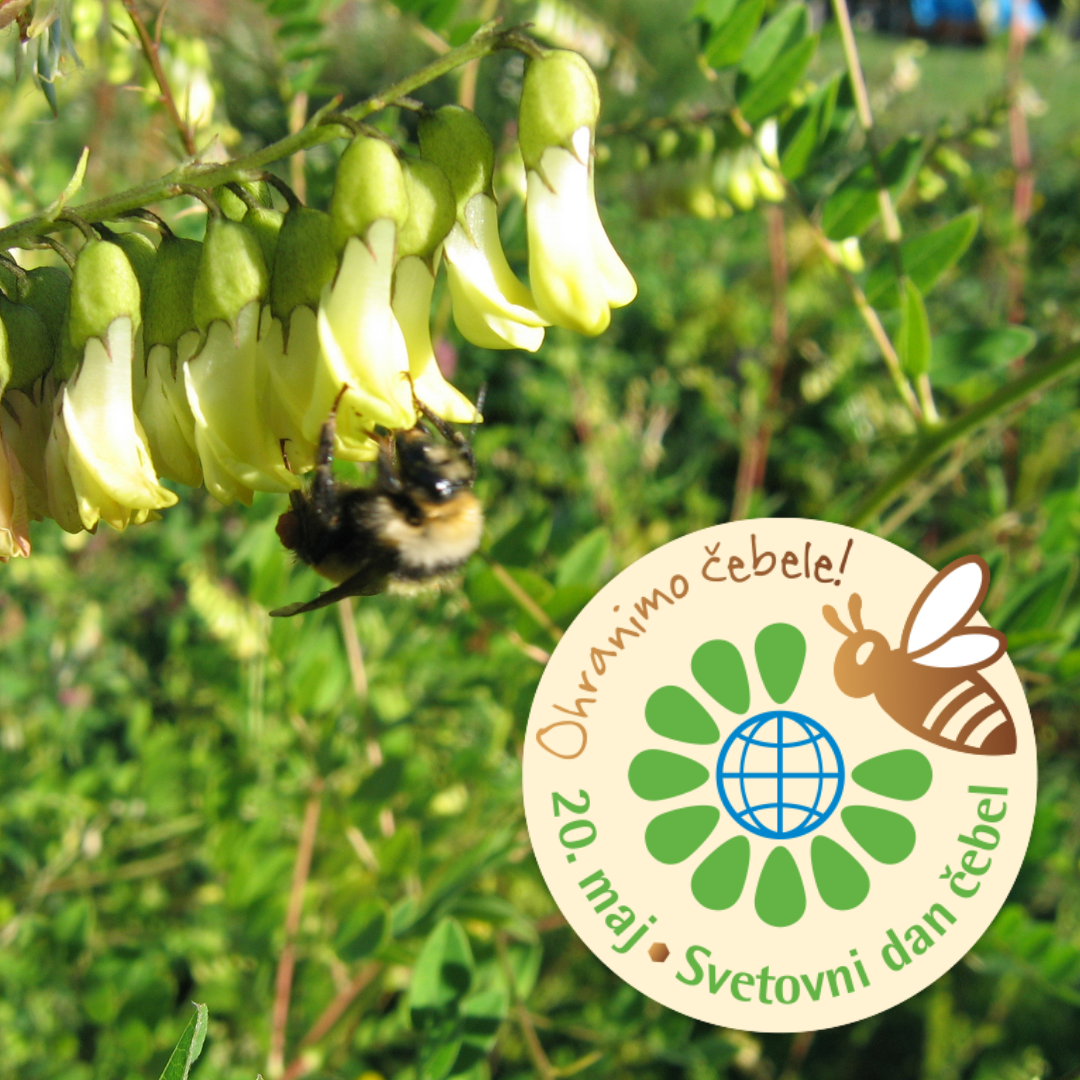
Honouring Bees

Few consider bees when taking that bite of delicious food. Despite the fact that they are invisible to most, the vast majority of land-based foods consumed by humans on the planet owe their existence to bees. Whether they are domestic or wild, bees are vital members of the community of those who labour to enable us all to eat.
Humans benefit from bees’ efforts to secure their own needs through collecting pollen, caring for their young, protecting their queen, and perpetuating their colonies. From canola to almonds, blueberries to beans, flowering food plants rely on bees and other pollinators. Honey, royal jelly, and bee pollen are also enjoyed around the world, often in combination with the very crops that were pollinated by bees.
Despite how very vital they are to the world’s food supply, bees are under threat from the loss of habitat. Their well-being is also undermined when their sole food source on vast landscapes is limited to one or two crops. Just like all of us, bees' well-being is linked to a diverse diet. Insecticides, particularly neonicotinoids, are harmful to bees; more and more jurisdictions are banning their use in an attempt to protect bees. Bees are also at risk from the increasing weather events associated with climate change, from mites that infest their hives and kill off their members, and from challenging winters that can destroy entire hives.
World Bee Day has been recognized by the United Nations since 2018, at the urging of the Slovenian Beekeepers’ Association. In the global north, May is the month when bee hives are waking up and food sources are becoming available to bees. In the global south, May is honey harvest time at the end of the growing season. No matter where we live on the planet, recognizing how important it is to protect bees and other pollinators is not just about promoting biodiversity, it is about our own food security.
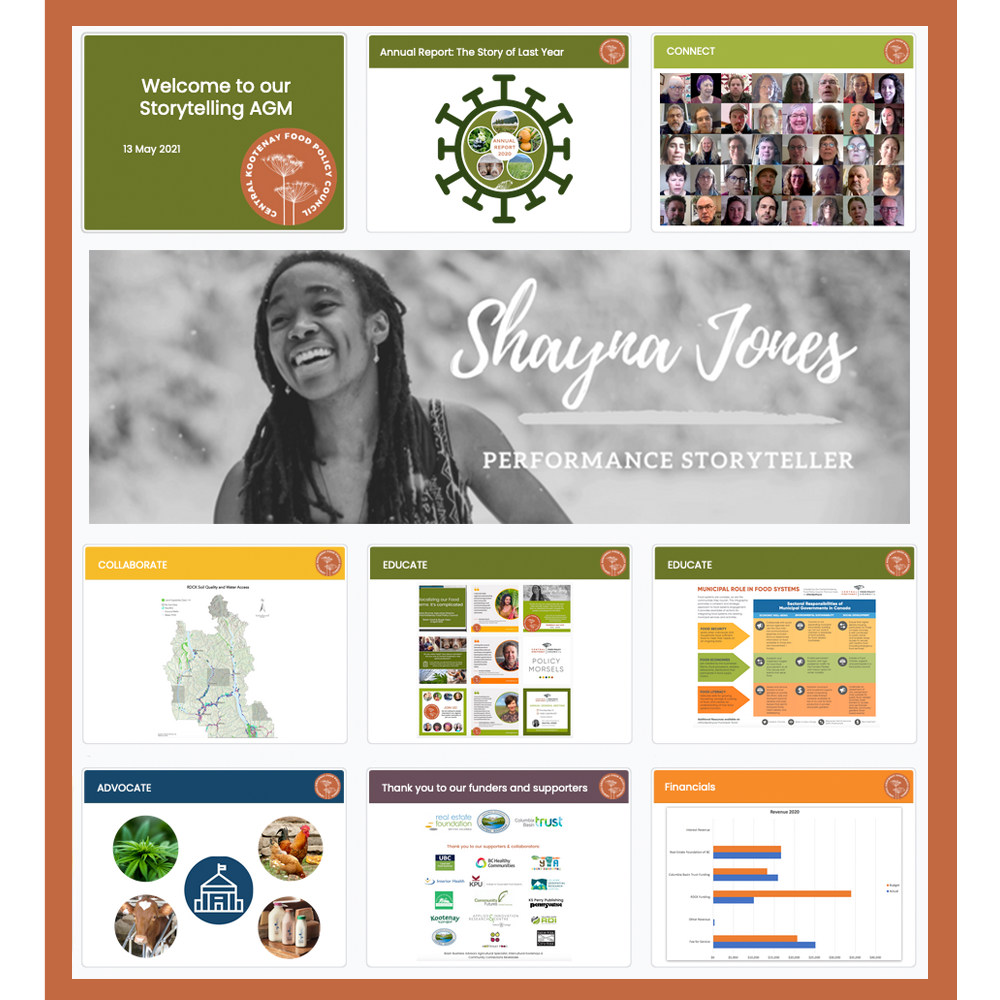
Celebrating our Storytelling AGM
On Thursday May 13th, we held our AGM for 2020. This year’s virtual meeting wove together stories of our work from the past year with enriching folktales performed by Kaslo, BC based spoken word artist Shayna Jones.
Twenty people attended the meeting, including Executive and Council Members as well as several people who were new to the Council’s work. In addition to hearing about the challenges and successes of the past year, we also looked ahead and were excited to welcome four new Council members!
Shayna Jones gave several captivating and inspiring storytelling performances throughout the meeting. She shared African and Afro-Diasporic folklore and mesmerized everyone in attendance with the depth and dynamism of her storytelling.
One of our Council members commented: "I just wanted to say thanks for a fantastic AGM! The storytelling was amazing, the presentations were engaging, and it was all in all a great way to spend a couple of hours. Thanks so much to everyone who contributed to making it what it was."
A first-time attendee commented: “I was impressed listening to the meeting, learned so much, and am so grateful there are people dedicated to this kind of work. I can see for myself, just from this meeting, that it is essential."
We are grateful to all who participated in our annual meeting and look forward to the year ahead, supported by partners and by our new and returning Council members.

Policy is Like Your Little Toe - Read on if You Want to Know Why
For most of us, particularly if you are not a business owner, policy is not something that we tend to pay attention to because there is seemingly no need. However, just like your little toe, when you stub it and it becomes painfully obvious that you have one, policy erupts into one’s consciousness when it hurts.
Have you ever wondered if you can raise chickens, is it okay to plant a food garden in your front yard, if you have any control over herbicide spraying in your neighbourhood, why is some information included on food labels but not others, if your zoning allows you to launch your dream food business?
These are all connected to policy. And that is where the Central Kootenay Food Policy Council comes in. The Council was established in 2016 with a goal of connecting those involved in food systems in the Central Kootenay and of helping to identify and resolve policy barriers to a resilient and just regional food system.
A food system is the place, relationships and activities that connect people to their food. The activities of a food system include production (fishing, farming, gardening and hunting), processing (personal or commercial), distribution, access (generally through grocers, markets, direct from the producer, emergency food providers), consumption and food waste. The full spectrum of food systems activities and needs are within the scope of the Central Kootenay Food Policy Council. If you are actively involved in our region’s food system, we would love to connect with and learn from you.
The Council meets five times each year, with our Annual General Meeting held each spring. Our 2021 AGM will take place on May 13th from 10AM - noon on Zoom. This online AGM will weave together our regular AGM business with vignettes performed by Kaslo, BC based spoken word artist Shayna Jones.
Our AGM is open to anyone who is interested in attending. Whether you are familiar with the Council’s work on just hearing about us for the first time, we encourage you to join us to learn more about our work and our plans for the year to come! We are also actively recruiting new members to the Council, so our AGM is a great chance to meet our members and get a feel for who we are and what we do.
Click here to read more about our upcoming AGM and details on how to join.
Join us for our Annual General Meeting on May 13th

Mark your calendars! Our Annual General Meeting is on Thursday May 13th from 10-12pm PDT. This online AGM will weave together our regular AGM business with vignettes performed by Kaslo, BC based spoken word artist Shayna Jones.
Our AGM is open to anyone who is interested in attending. Whether you are familiar with the Council’s work on just hearing about us for the first time, we encourage you to join us to learn more about our work and our plans for the year to come! We are also actively recruiting new members to the Council, so our AGM is a great chance to meet our members and get a feel for who we are and what we do.
Meeting Materials
Here are the Zoom details:
Zoom Link:
https://us02web.zoom.us/j/84221193583?pwd=bU5YRDhxc3gwQXpGWUtkRU9pY096dz09
Meeting ID: 842 2119 3583
Passcode: 408487
One tap mobile:
+17789072071,,84221193583#,,,,*408487# Canada
+12042727920,,84221193583#,,,,*408487# Canada
Dial by your location:
+1 778 907 2071 Canada
+1 204 272 7920 Canada
+1 438 809 7799 Canada
+1 587 328 1099 Canada
+1 647 374 4685 Canada
+1 647 558 0588 Canada
Find your local number: https://us02web.zoom.us/u/kd4BDRQfh

Cultivating Connections and Community through Storytelling

Imagine you are the only one like you in your community. There is something that makes you special — and obvious. Each time you leave the sanctuary of your home you have to brace yourself for the inevitable stares, maybe some comments and always the question "where are you from?" As if you don't belong to this place you call home.
Shayna Jones doesn't have to imagine that experience. It is her lived reality. If you ask someone in her home community of Kaslo if they know her by name, they may say no. If you ask if they know the Black woman who lives in the village, they will say "oh yah, I've seen her."
Many if not all of us who live here do so because we wish to be rural dwellers. We value the natural beauty around us, the bird song, the smells unique to each season when the earth breathes, free of black top and concrete. But in a region that has been predominantly white since settlers first arrived here, it takes courage to live rurally as a Black, Indigenous, or person of colour.
This Shayna knows firsthand. Founder of the Black and Rural Project, she is connecting with other Black rural dwellers across Canada. She is forging relationships, drawing out stories, and celebrating the lives of Black people who, like Shayna, choose to put down roots where the stars glow at night.
Food is deeply connected to place, to health, to community, and to culture. The Central Kootenay Food Policy council is dedicated to supporting vibrant, healthy, and just food systems in this place we call home. On our journey to better understand and to take action against systemic racism, we are seeking to bring in new voices and perspectives. To find different ways of doing things that are not so bound to white, bureaucratic conventions.
We are excited to feature Shayna and her storytelling at our upcoming AGM. And we are following her lead by integrating a more narrative style to the business of our annual meeting.
Stories are how we create bonds with each other and with a place. They are how we learn to understand the past, navigate the present, and prepare for the future. Join us on May 13th to hear stories by Shayna and stories of our Council over the past year.
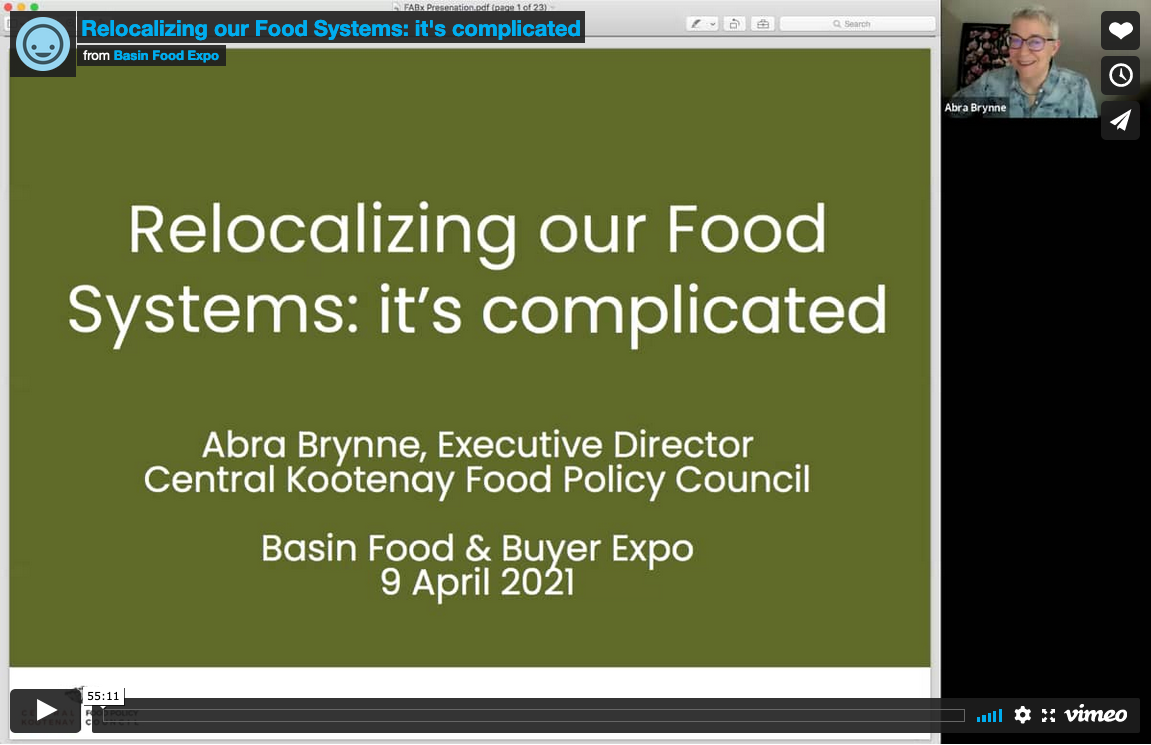
Relocalizing our Food Systems: it’s complicated - Recording now available
A recording of CKFPC Executive Director Abra Brynne's presentation “Relocalizing our Food Systems: it’s complicated” is now available to watch online.
This presentation was the keynote for the 2021 Basin Food & Buyers Expo and touches on the challenges and opportunities in 2021 for relocalizing our food systems. Abra draws on a lifetime of experience participating in the food system in diverse ways to explore the complex policy and food systems landscapes that hinder or catalyze our vision for a healthy, resilient and just food system in the Columbia Basin.
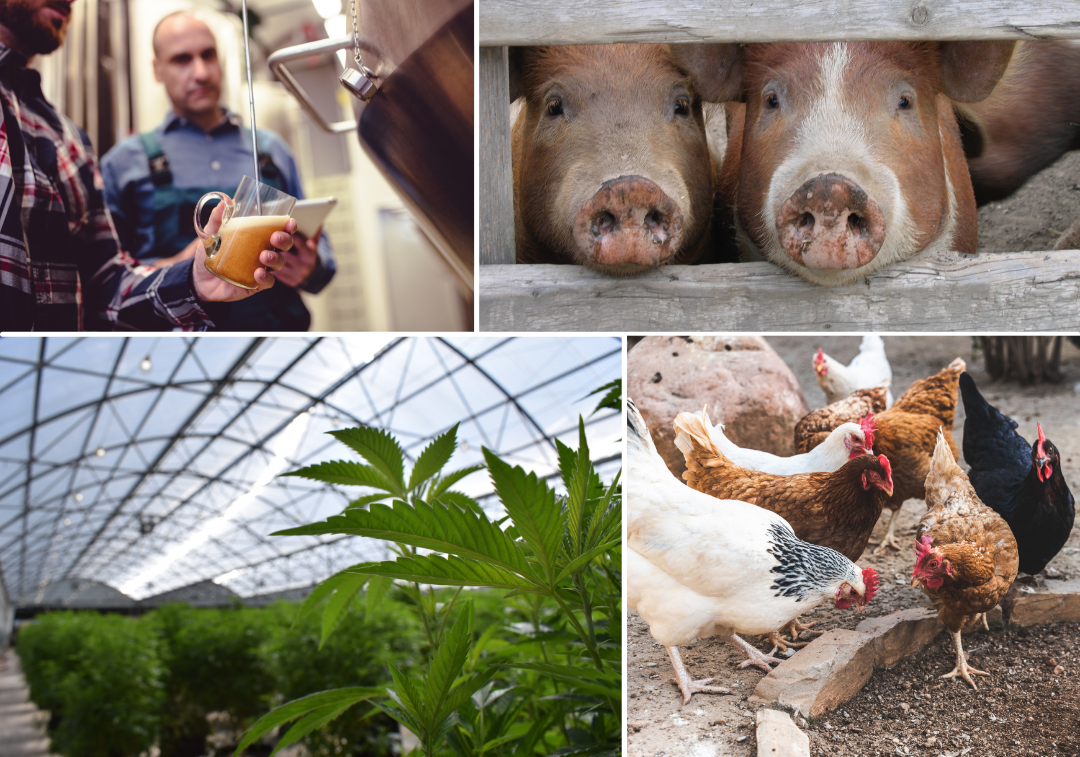
Call for new Council Members! Joins us as we work together to solve policy challenges

Do you raise meat? How about cannabis? Are you one of Central Kootenay’s new spirits producers? If you said yes, you will know that you are doing business in three of the most heavily regulated sectors in the agriculture / food world. And you will know that just because you solved your current challenge with policy does not mean that another one will not crop up next month, next year, some time….
The Food Policy Council loves to problem solve when it comes to policy. We are enthusiastic about figuring out how to make it all work better, to achieve our vision of a healthy, resilient, just regional food system. We want to connect with you and learn from you. Consider joining our Council. We won’t ask much - just that you bring yourself, your experience and your ideas to the five meetings we hold each year.
If you want to learn more, please check out our website, social media links, or contact Abra: info@ckfoodpolicy.ca. If you'd like to learn more about what we're about, consider joining us for our AGM on May 13th.
Policy Morsels - April 2021 newsletter
Check out the latest edition of Policy Morsels, our quarterly e-newsletter with updates on our activities, events, and the latest policy happenings. Our April 2021 edition includes information about our upcoming AGM, the relaunching of working groups, project updates, and more!
Click here to sign up to get our e-newsletter delivered to your inbox.
2021 Basin Food & Buyer's Expo
The Central Kootenay Food Policy Council was honoured to have been a part of the annual Basin Food & Buyer's Expo on April 9, 2021. This virtual event brought together food producers, processors and food buyers in the Columbia Basin and provided opportunities for learning, sharing and networking as well as the celebration of local food.
Thank you to the Columbia Basin Trust for supporting and presenting this important annual event. Even organizers Shauna Fidler & Damon Chouinard did an amazing job of organizing and convening this event, which was a vibrant celebration of the passionate and talented people behind our vital local food system.
CKFPC Executive Director Abra Brynne kicked off the event as the keynote speaker. Her presentation “Relocalizing our Food Systems: it’s complicated” touched on the challenges and opportunities in 2021 for relocalizing our food systems. She drew on a lifetime of experience participating in the food system in diverse ways to explore the complex policy and food systems landscapes that hinder or catalyze our vision for a healthy, resilient and just food system in the Columbia Basin. You can watch a video of Abra's presentation below or on Vimeo.

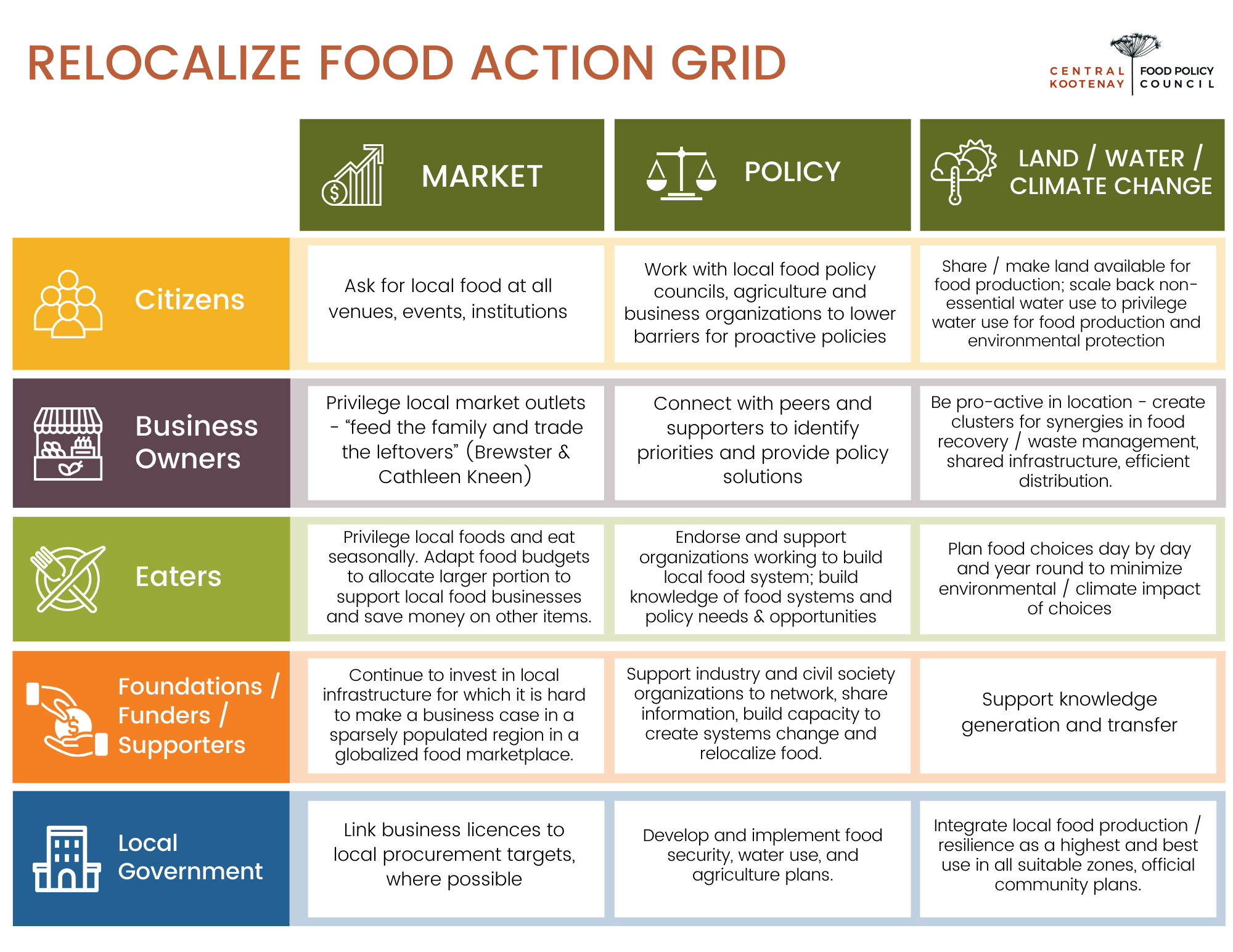
In her presentation, she shared the Relocalize Food Action Grid. This table listed a range of actions that different actors can do that are key to relocalizing our food system. Modelling proactive measures to relocalize our food system and mentoring others to do the same will help to foster a healthy, resilient and just food system in the Columbia Basin and was a key takeaway from Abra’s dynamic presentation.
New Community Food Centre in the North Slocan Valley
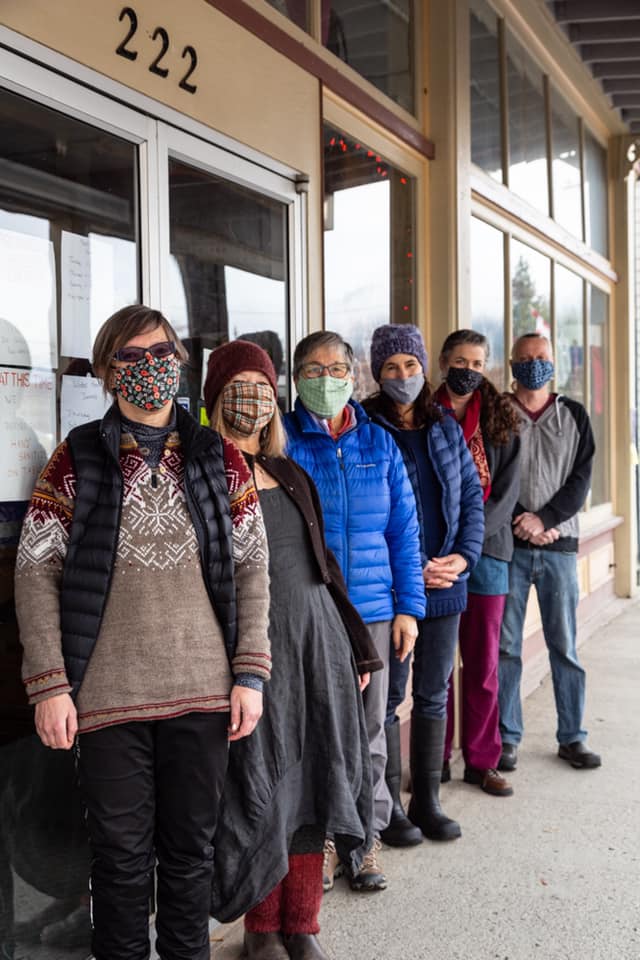
The Silverton Co-work Society recently received close to $900,000 in funding to create a North Slocan Valley Community Food Centre in Silverton. The funding will support the creation of a community food centre that will have programs, resources and infrastructure that serve to strengthen community resilience and support the local food economy.
The funding comes through the provincial Community Economic Recovery Infrastructure Program (CERIP). Additional funding has also been provided by FLNRORD Rural Community Development and The Village of Silverton.
According to the press release, plans include renovations to the building, bringing it up to current building code with COVID-19 ventilation requirements, and a space designed to be both functional and flexible. A commercial kitchen will be available to local food producers, caterers, and food-related home-based businesses. Space for food storage and a culinary tool library are included in the design, as are spaces large enough for educational programs, workshops, and potentially an indoor market or pop-up cafe
The food centre will be housed in the same building as the co-working space and will provide unique opportunities for cross-pollination and collaboration between the two initiatives that both focus on community programming and economic development.
“I love seeing this kind of tailored investment that is driven by what is truly needed in and will serve the local communities. This food hub will enhance the opportunities for skills development, production, and provide a venue for people to come together around food,” commented Food Policy Council Executive Director, Abra Brynne,
The establishment of this community food centre would not have been possible without the hard work of local farmer and Council Member, Mick Wilson, whose efforts as a community member and vice-president of the SIlverton Co-work Society helped secure funding for this initiative.
Join us March 11th for our next Council Meeting

Join us for our next Central Kootenay Food Policy Council Meeting on Thursday March 11th from 10 – 11:30am PST via Zoom.
Everyone is welcome to attend. If you're interested in attending for the first time, please contact Abra at info@ckfoodpolicy.ca.
Meeting Materials (PDF):
The Zoom meeting link can be found in the Agenda.
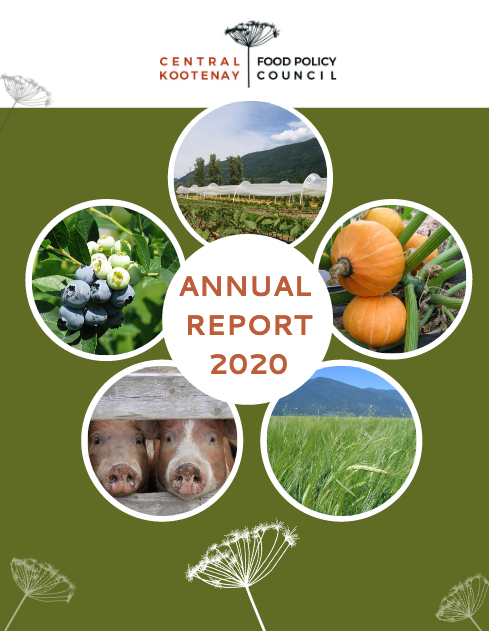
2020 Annual Report
Check out our hot-off-the-virtual-press 2020 Annual Report and read about all of the amazing work we’ve been able to do over the past year in collaboration with our partners and with support from our generous funders.
Despite the challenges of pandemic, like many other organizations we were able to respond to increased demands on our time and contribute our part to supporting food resiliency and food security in the Central Kootenay region and elsewhere.
We’re so grateful for our Council members, supporters, funders and partners who enabled us to achieve what we did.
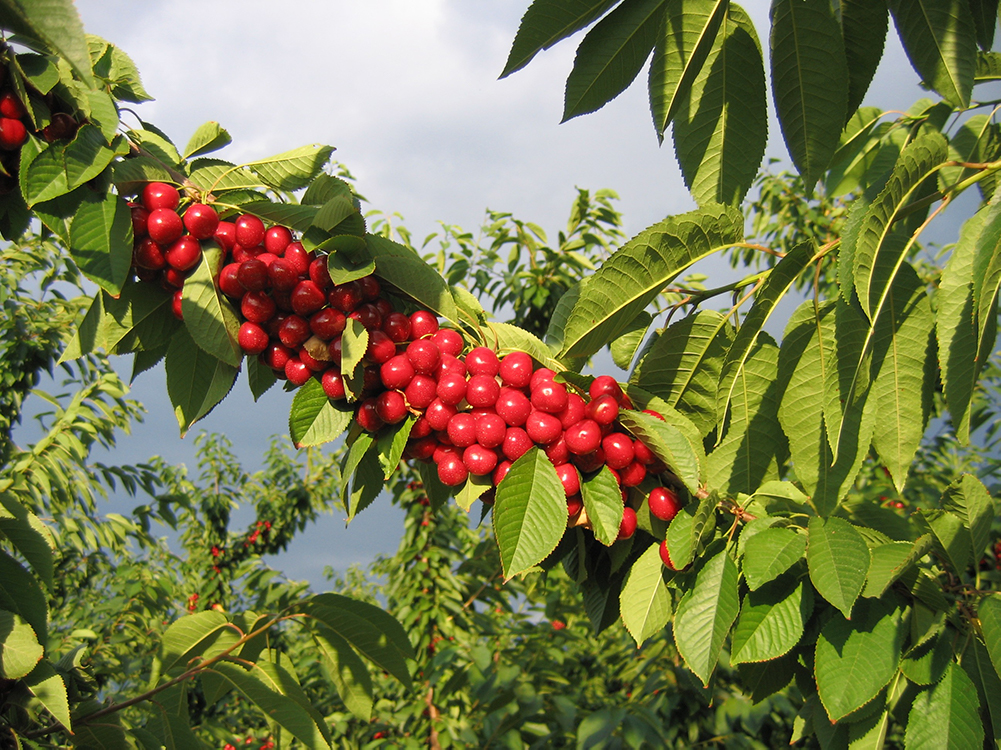
New Regional Food Hub in the Creston Valley
Last week, the BC government announced support for a new food hub in the Creston Valley. This is an exciting announcement for both the Creston Valley and the Central Kootenay region that will bring increased opportunities for farmers and food producers as well as strengthen food security in the Kootenays.
According to the province's press release, the B.C. government, in partnership with the Regional District of Central Kootenay and Fields Forward, is investing up to $500,000 to purchase food-processing equipment and cover other startup costs. The hub will help small- and medium-scaled businesses access shared food and beverage processing space and equipment to increase their production and sales and reach new markets.
“The Creston Valley is known for its thriving agricultural sector that produces a wide variety of crops and products that are highly valued throughout the Central Kootenay”, commented Council Executive Director, Abra Brynne. “Having access to community-based equipment and facilities as well as distribution and sales support will allow farmers and food producers to strengthen their business, create value added products, and reach new markets. This food hub will contribute significantly to improving the local economy and increasing food security across the region.”
The establishment of this food hub would not have been possible without the hard work of Council Member, Elizabeth Quinn, whose leadership of Fields Forward helped secure the funding for this initiative.
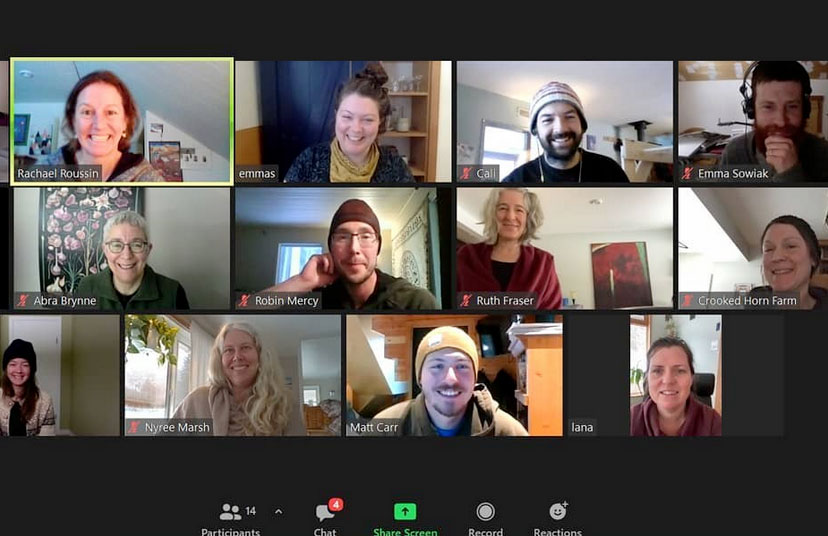
Kootenay Organic Growers Society AGM

On February 21st, 14 of our region’s farm leaders in the organic sector came together for the Annual General Meeting of Kootenay Organic Growers (KOGS). As became clear through the various reports from the Board, the organization is in a very positive place: there are plenty of volunteers to meet the needs of the Board and of the Certification Committee; and KOGS bank account also provides a healthy buffer in case KOGS has any unexpected demands, such as additional costs related to bringing in an inspector to provide inspection services of the farms during a pandemic. Following the business of the AGM, everyone stuck around for a fruitful discussion about farming, seeds, and the finer points of wind-resistant greenhouse structures.
To learn more about KOGS, check out their website and Facebook page.
Check out our blog post Celebrating Kootenay Organic Growers by our Executive Director Abra Brynne to learn more about the history and evolution of the organization.
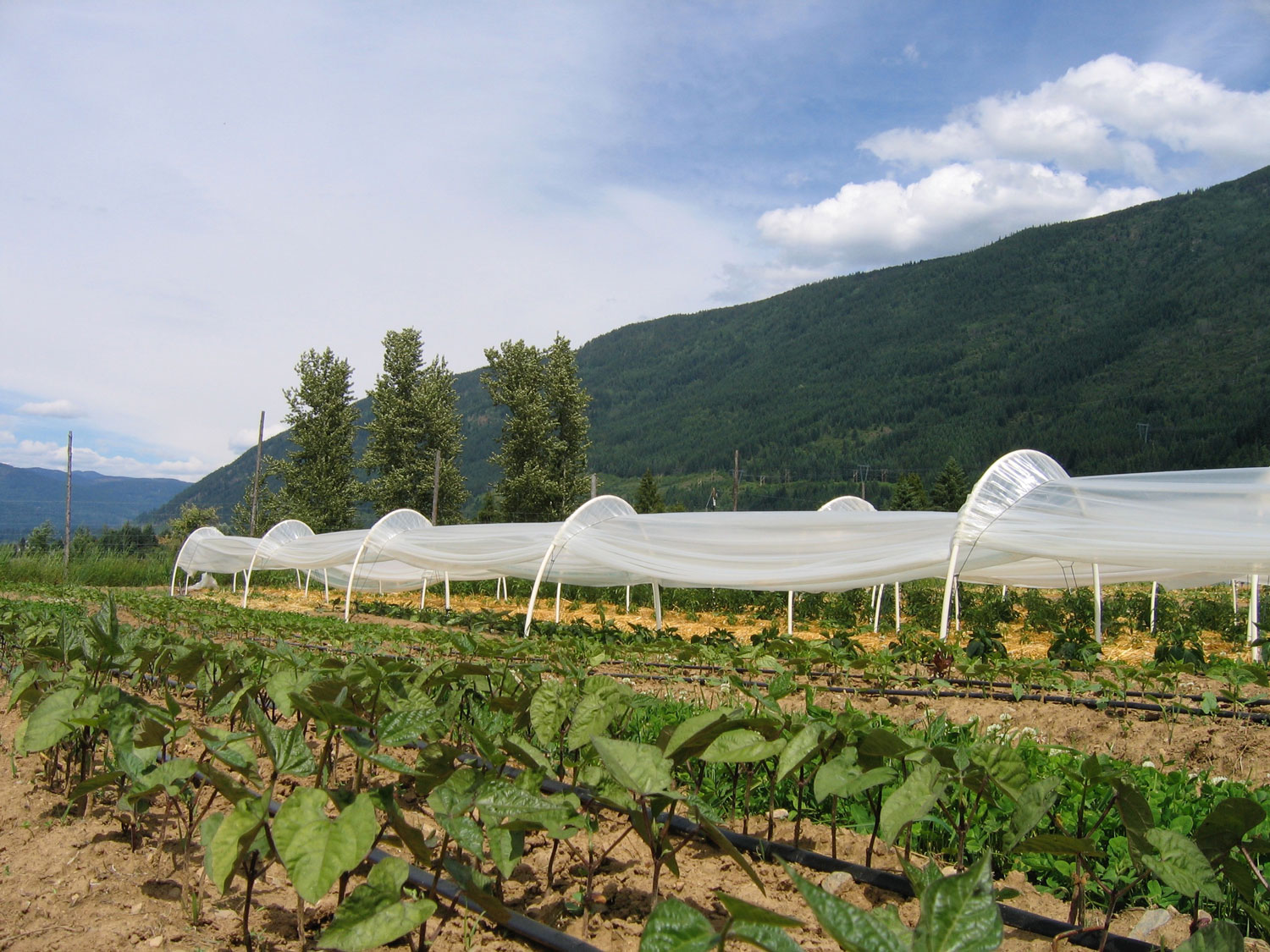
Celebrating Kootenay Organic Growers
by Abra Brynne, Executive Director

I started attending Kootenay Organic Growers meetings shortly after a group of farmers came together to form it in the mid 1990’s. The idea was to create a farmer-run organization that would allow local access to certification, keep the costs down, and allow farmers to distinguish themselves from other claims in the marketplace. Among those early visionaries were: Jules Delaney, David Bromley, Gregoire Lamoureux, Bonnie Baker, Habibe Gonzales, John Johnson, Carol Ross, Dan Ferguson, Yana Maltais, Pat Armstrong, Ed Heide, and Park Cowin.
At the time I was the Manager of the cashiers and customer service at the Kootenay Coop. More and more customers were coming in asking about organics and wanting to know what we had in the store and if the label meant anything. I wanted to be able to answer truthfully so I tracked down and read the standards and then started attending KOGS meetings.
It did not take me long to realize that I could put my laptop and administrative skills at the service of KOGS, taking minutes and writing letters, for example, to the Ministry of the Environment to try to curtail the spraying of pesticides near organic farms. I also created a seasonal produce guide for KOGS, using my then Co-op co-worker’s artist in residence, Gordon Seward’s wonderful art. I am pleased to know that this guide is still in use and readily available.
I championed the Coop supporting this fledgling group of farmers who were committed to farming in a way that is respectful of the earth. I felt that KOGS would grow stronger if the Coop made a point of privileging certified organic produce from area farmers and the Coop agreed. And I continued to show up and to volunteer with KOGS: over the years I have been on the Board many times, I was the KOGS rep to the provincial organic organization (COABC), I was the KOGS representative on the Standards Review Committee, and I have been a member of the certification committee on and off for many years. If you really want to understand what it means to eat organic foods, I highly recommend a course of study that results from hanging out and working alongside organic farmers.
I have also observed heartening changes over the years. At one point the membership dwindled and those of us on the Board had to do double duty on the Certification Committee. In more recent times, we have seen a consistent increase in the number of farmers joining KOGS and volunteering on its Board and Certification Committee. I have also seen an increase in younger farmers, many of whom have succeeded in passing that vital 10 year mark in business that indicates a level of stability for their business and a vital contribution to our local food economy and collective food security.
In the years that I have been working with KOGS, I have developed many deep friendships with some truly wonderful farmers in this region and across the province. And I know that I am privileged to have done so - the volunteer work has been a small price to pay for the relationships and knowledge that I have gained.
So on a Sunday in February, I joined my farmer friends and Rachael Roussin of Kootenay Boundary Farm Advisors at yet another KOGS Annual General Meeting. It is truly worth celebrating the vision of its founders and the tenacity that has brought about the success that KOGS is: in our little part of the province, a region often overlooked as a farming area, for a quarter of a century, we have provided services, supports and certification to area farmers for the benefit of our region’s food culture and economy. I am in awe of and so appreciative of the countless hours of hard work that farmers have been putting in to KOGS over the years, on top of all that they do to bring us precious food.
To learn more about KOGS, check out their website and Facebook page.
Celebrating Diversity, Supporting Choice
By Abra Brynne, Executive Director
I came out as queer in 1993. It had been a long journey, recovering from a childhood marked by sexualized violence that kept me from any notion of sexual choice. When I had finally healed enough to understand who I truly was, it felt amazing. But it was also scary.
Given the size of the queer community in the Kootenays in the early 1990's it felt like I had chosen the safest time and place to come out. Nevertheless, it still felt unsafe to kiss my new girlfriend in public or to walk down the street holding hands. When we moved together to a small village I worried that the word would spread that we were a couple. Happily, we were never subjected to violence, but I grew accustomed to the loneliness of never being able to joyfully express my love in public in any way. I also vividly remember how excited I was when I found the first lists of queer people in history and discovered my first queer business directory.
Like many households in the 1960's and 70's, my Dad's views dominated. I distinctly recall him reacting to a newspaper article he was reading, exclaiming that "all the homosexuals should be taken out and shot". Small wonder I did not come out until I was in my 30’s.
My Dad also determined my childhood culinary experiences. Our diet was dominated by meat and potatoes. No fresh garlic, ever. No peppers, no rice, rarely even pasta. As each of his offspring left home we dove headlong into food adventures. I shall never forget my wonder at the explosion of flavours that hit my mouth the first time I tried hummus. I thought I had died and gone to heaven.
So why is being queer and my food history relevant? There are too many tragic stories of childhood victims becoming abusers themselves. I was lucky enough to have a disciplined but loving household to grow up in and ready access to nature to heal my soul. The violence I experienced as a child was a group event. Watching others also being abused instilled in me a passion for justice that has continued throughout my life. As the founder of this Council, I incorporated justice into its DNA - our mission is to build a just, sustainable and prosperous food system. I believe there can be no justice if we do not address systemic racism.
I would love to see the Council's annual Farm & Food Directory be a place where we could identify and celebrate diversity — in culture, in food, in place. It would be easy, in both the print and online version, to provide ways for Black, Indigenous, and People of Colour who farm or own a food business to make that known in their listing.
This would make it easier to seek out and to support BIPOC-owned businesses, as one small but meaningful way to counter systemic racism. There are multiple reports over many years that document the extra barriers that BIPOC entrepreneurs face. To provide a means to connect new customers to their businesses seems like the least the Council could do. Nevertheless, as a queer person with personal experience of violence, the last thing I want to do is to expose anyone to an increased risk of violence.
Will the benefits outweigh the risks to BIPOC entrepreneurs should they choose to self identify in our Directory? That is a question only they can answer for themselves.
The Council wants to offer that choice to BIPOC food entrepreneurs. As a result, in our fourth annual Directory and onwards, in support and celebration of diversity, we are offering the ability for any farmer or food processor who is listed in the Directory to self identify as BIPOC, queer, or youth (<30years old) entrepreneurs, if they so choose.
Our Directory is a free marketing tool for any independent farmer or food processor who resides in or sells products in the Central Kootenay. If you fit the bill and don't already have a listing, head over to centralkootenayfood.ca and create an account. And if you already have a listing, please review and update it as necessary before April 15th in order to be included in our fourth annual Directory.
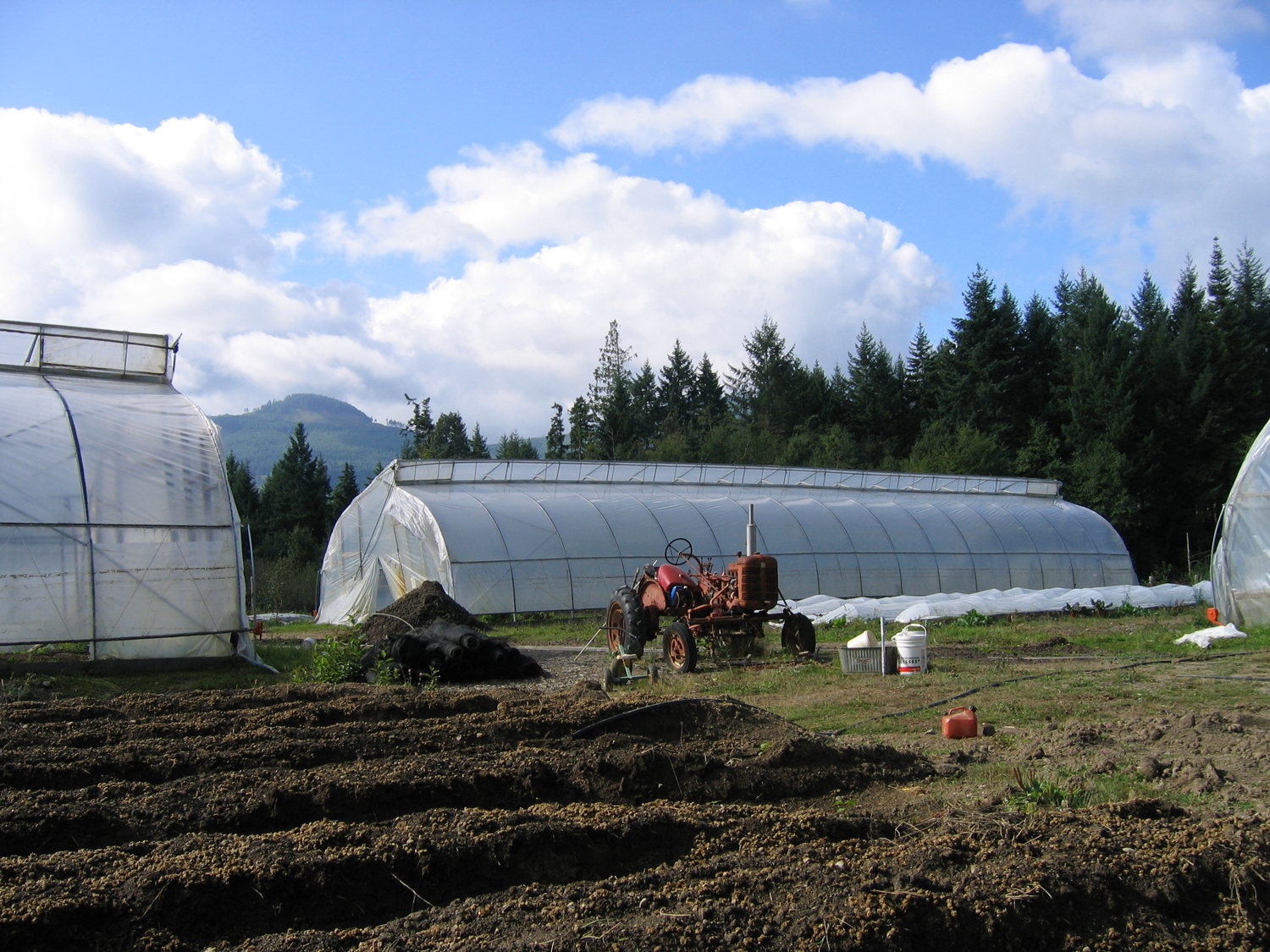
Survey: Farming in a pandemic

The impact of the pandemic has been felt differently across the Columbia Basin and farming sectors. In order to better understand its impacts and how to provide the supports for adaptation and stronger farm businesses, we have created a survey to learn how last year went and what is being planned for the year ahead.
And if you farm in the Columbia Basin, please take this survey and share it with other farmers. All surveys must be completed before the end of February 2021.
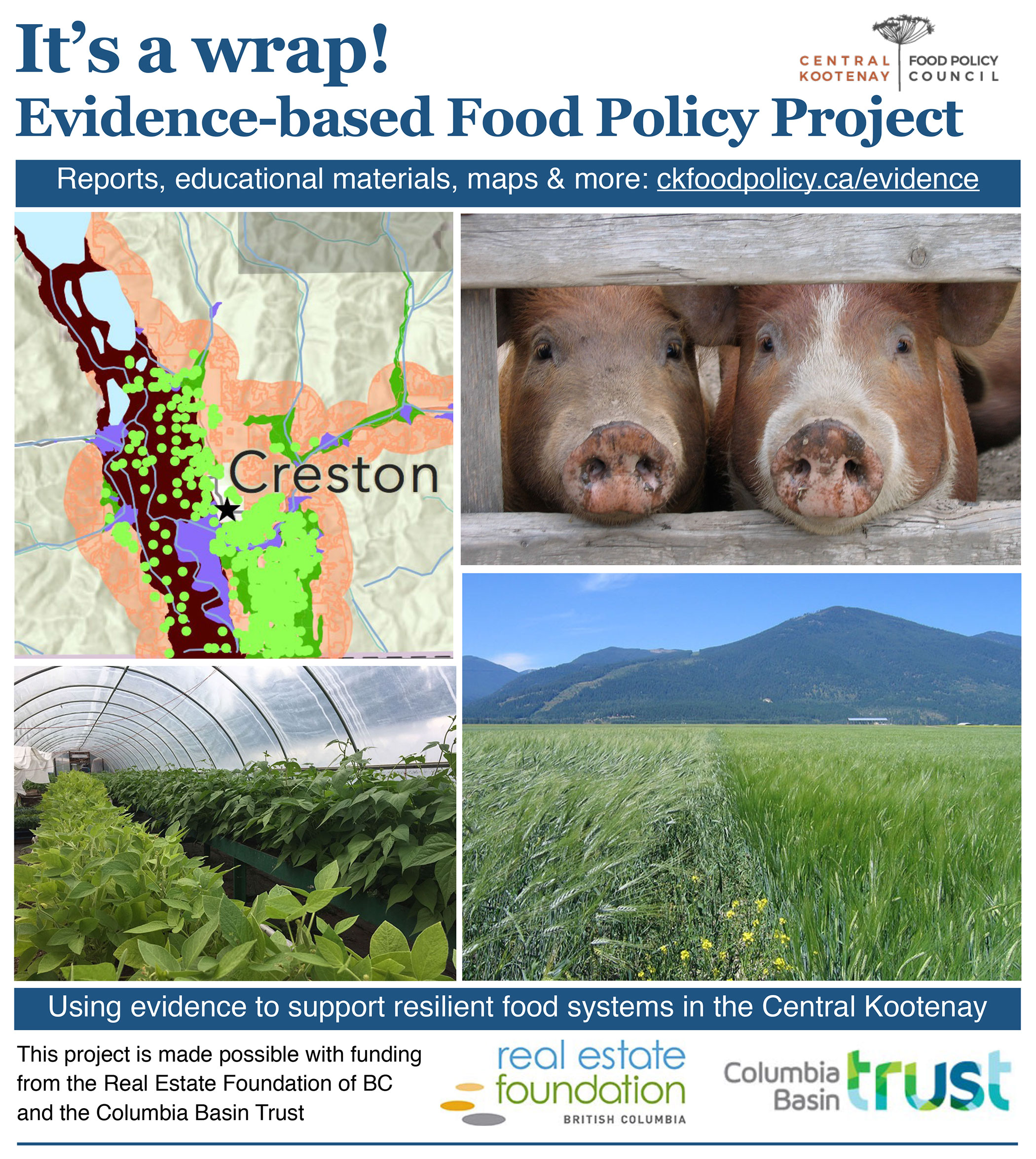
Evidence-based Food Policy Project Wraps up
Our two year project exploring how to use evidence to support resilient food systems in the Central Kootenay wrapped up in December 2020.
The project worked with key partners to develop an evidence base and strategic rationale for policy development that can best support and promote sustainable and viable land and water use and vibrant food economies for the long term.
Visit our project web page to view reports, educational materials & more.
Food Justice & the Food Policy Council
by Abra Brynne, Executive Director

In January 2020, the Food Policy Council committed to integrating into our work programming focused on systemic racism and food. The COVID-19 pandemic impacted our plans for 2020, just as it has done to everyone, everywhere. Nevertheless, the urgent need to understand how systemic racism is manifested in food systems has only been highlighted by the events of 2020. Outbreaks at large meat processing plants shone a light on the heavy dependence on racialized communities to provide the hard labour that subsidizes our meat supply chains. Similar outbreaks amongst migrant workers exposed many Canadians to previously well-hidden programs and employment structures that have limited protections for these hard-working individuals from countries mostly in the global south that perform labour few Canadians are willing to assume.
The ways in which systemic racism is manifested through food systems are myriad, complex, and deeply entrenched over time around the world. From land stolen from Indigenous people on Turtle Island (North America) and elsewhere, to the heavy reliance on the slavery of Black people for the expansion of colonial activities around the world, the link between racism and food systems is inescapable. More recently the effects of climate change and the pandemic that disproportionately impact Black, Indigenous and People of Colour (BIPOC), peasant, and northern communities also demonstrate the tragic and profoundly unjust impacts of systemic racism.
As a currently caucasian-led organization, the Council has been exploring our responsibilities and role in addressing systemic racism. Our World Food Day blog focused on unceded land, truth and reconciliation. We are proud to be a founding member of Intercultural Kootenays Society, formed to address root causes of racism in our communities, to build intercultural competencies, and to support people experiencing inequitable treatment. Intercultural Kootenays received BC Society Status in October 2020, has recently hired a part time Coordinator, and is working alongside other partners to build awareness of the existence of racism within our communities and of measures that can be taken to address it.
With this column, we are launching a regular series that will feature articles by guest BIPOC authors, as well as by our Executive Director. This Food Justice series will seek to deepen our collective understanding and to advance our work to address systemic racism. The Council will also be setting a target and seeking to diversify our Council membership to include more BIPOC and other marginalized groups. We will be looking to our Council members and to our partners to make connections and recommendations across the Central Kootenay to help the Council meet our diversity goals. Please contact Abra at any time on this matter: info@ckfoodpolicy.ca.

Five Years On
By Abra Brynne, Executive Director

Five years ago, on December 12th, the Paris Climate Agreement came into being. It gave people hope that at long last the political leaders of countries around the world were taking climate change seriously enough to set ambitious targets that reflect the gravity of the existential threat that faces the planet.
In the intervening years we have seen a few measures taken that reflect the seriousness of the crisis before us. Tragically, we have also seen repeated failures here in British Columbia, in Canada, and in other parts of the world, to meet the targets set within the Paris Climate Agreement framework - most of which have since been demonstrated as being woefully inadequate to change the trajectory we are on.
Scientists have been warning us for decades about the acidification of the oceans and of the loss of marine species. On the land, scientists and farmers have been documenting changes in pests and diseases, in when and how precipitation arrives, and in crop failures attributable to climate change. Rather than gentle rain that can be absorbed by parched soils, rain often comes now in torrents that remove topsoil, destabilize mountain sides and deprives ecosystems of precious water that nourishes all life.
Winters in the Central Kootenays used to be characterized by four months of predictable snowfalls that accumulated over months, sometimes in large amounts, and then went away again, hurried by March rains. Now those rains come randomly throughout the winter, onto snow or frozen bare ground. We are at risk of reduced snowpacks that not only provide so much delight to outdoor enthusiasts but also provide a source of melted water to keep our streams and rivers flowing during the summer months. Our glaciers, another critical source of water, are rapidly retreating. And the impacts of climate change are much more dire in many other parts of the world.
On this fifth anniversary of the Paris Climate Agreement, I am hoping that we will take the incredible will power and courage that so many have demonstrated in the face of COVID-19 and apply it to climate change. Time has run out for us to keep doing business as usual. We need to decarbonize our economies and live within the ecological limits of the planet. We need to truly listen to and follow the leadership of Indigenous people everywhere who have deep knowledge of how to live sustainably on the planet. And we need to do it all together. For the sake of the earth and all living beings on it, now and in the future, let’s demonstrate that we can be good ancestors.
Join us December 14th for our next Council Meeting
The next Central Kootenay Food Policy Council Meeting is happening on Monday December 14th from 1 - 2:30pm PST via Zoom. Everyone is welcome to attend. If you're interested in attending for the first time, please contact Abra at info@ckfoodpolicy.ca.
Meeting Materials (PDF):
- Agenda for December 14th Council meeting
- October 6th meeting minutes
- Executive Director staff report
- Three financial reports: Income Statement, Balance Sheet, and Project Summary Report
- Draft Meeting Schedule for 2021
The Zoom meeting link can be found in the Agenda.

Cannabis & the Food Policy Council
by Abra Brynne, Executive Director

When I moved to the Kootenays in 1990, my first major social outing exposed me to the cannabis trade in the region. As a non-smoker, I have never indulged, but as someone working on food systems and agriculture, it was always evident to me that cannabis is inextricably linked to the food economy of our region.
There is plenty of academic and anecdotal evidence that connects cannabis to countercultural influences. Perhaps it is linked to the ancient practices and cultures of the Indigenous peoples in this region, but the Kootenays has long attracted successive waves of non-conforming groups. The Doukhobors arrived in the early 1900s and included the cultivation of hemp in agricultural endeavours that sought to meet their core needs. Then came the Quakers, the draft dodgers, and repeated waves of “back to the landers”. All these groups have contributed to the somewhat distinct culture that exists in the Kootenays, enabling the mostly peaceful co-existence of loggers, lawyers, canoe builders and cannabis producers, among others.
While there are clusters of cannabis production in various areas and pockets of the Central Kootenay, the positive impact of the sector on the economy and the agricultural sector can be felt throughout our region. Cannabis has provided a stable income for farmers not able to achieve it solely through the production of food. It has also provided employment for a host of individuals who need flexible or seasonal labour that can accommodate the demands of family or other work obligations. The cannabis sector has resulted in the creation and success of ancillary businesses that benefit other sectors, such as greenhouse infrastructure, high performing filters, and other production supplies. And the cash economy driven by the cannabis sector has helped to catalyze the services, niche stores, multiple restaurants, and coffee shops that contribute to the quality of life here. Most importantly, the cannabis sector’s multiplier effects are likely amongst the highest of any sector here, circulating cash through the local economy and supporting diverse direct and indirect jobs.
In April 2019, I was honoured to be asked to moderate the closing panel of the first ever public gathering of cannabis producers in the region. Organized by Kootenay United Cannabis Association, this event brought together active members of the cannabis sector to best determine needs and opportunities following the legalization of recreational cannabis. By the end of 2019, I was asked to be part of a policy brainstorm on the barriers blocking a safe and successful transition to legal cannabis production. And in May of 2020, the Food Policy Council entered into a contract with Community Futures’ Cannabis Business Transition Initiative, to provide policy and sector development supports.
Like any heavily regulated sector, the barriers for small-scale producers are very significant. The cannabis sector also struggles to extract itself from under a long-standing prohibitionist cultural norm that has rendered most of its operators invisible. The 2018 legalization of recreational cannabis in Canada ostensibly provided an opportunity for these producers to join mainstream commerce. However, this will not happen without significant supports and some substantive policy change.
It is well known that the Kootenays produces high quality cannabis that is sought around the world. What is not so well understood is that this comes from the incredible expertise and dedication of many gifted small-scale producers.
The Cannabis Business Transition Initiative (CBTI) is an innovative initiative to provide the necessary supports for our area’s cannabis producers. The CBTI is being watched with great interest and some enthusiasm by both the provincial and federal governments. The CBTI team is also mentoring a Vancouver Island-based Community Futures to launch their own such initiative.
The Central Kootenay Food Policy Council is pleased to partner with Community Futures by providing policy and advice and sector development services. I am honoured to be facilitating a newly formed Cannabis Economic Development Task Force made up of cannabis leaders in our region. With a first meeting in December 2020, this group will focus on:
- creating a regional appellation to promote Kootenay cannabis, modelled after initiatives like that run by the Vintners Quality Alliance (VQA)
- influencing the development of the direct to retail or “farm gate” sales program recently announced by the BC government, to ensure that it serves small scale producers and does not add new barriers
- monitoring and advocating for improved federal cannabis policy that better supports the transition of the legacy growers in our region.
More information about the CBTI can be found here: https://futures.bc.ca/grow-your-business/cannabis/cbti-webpage/
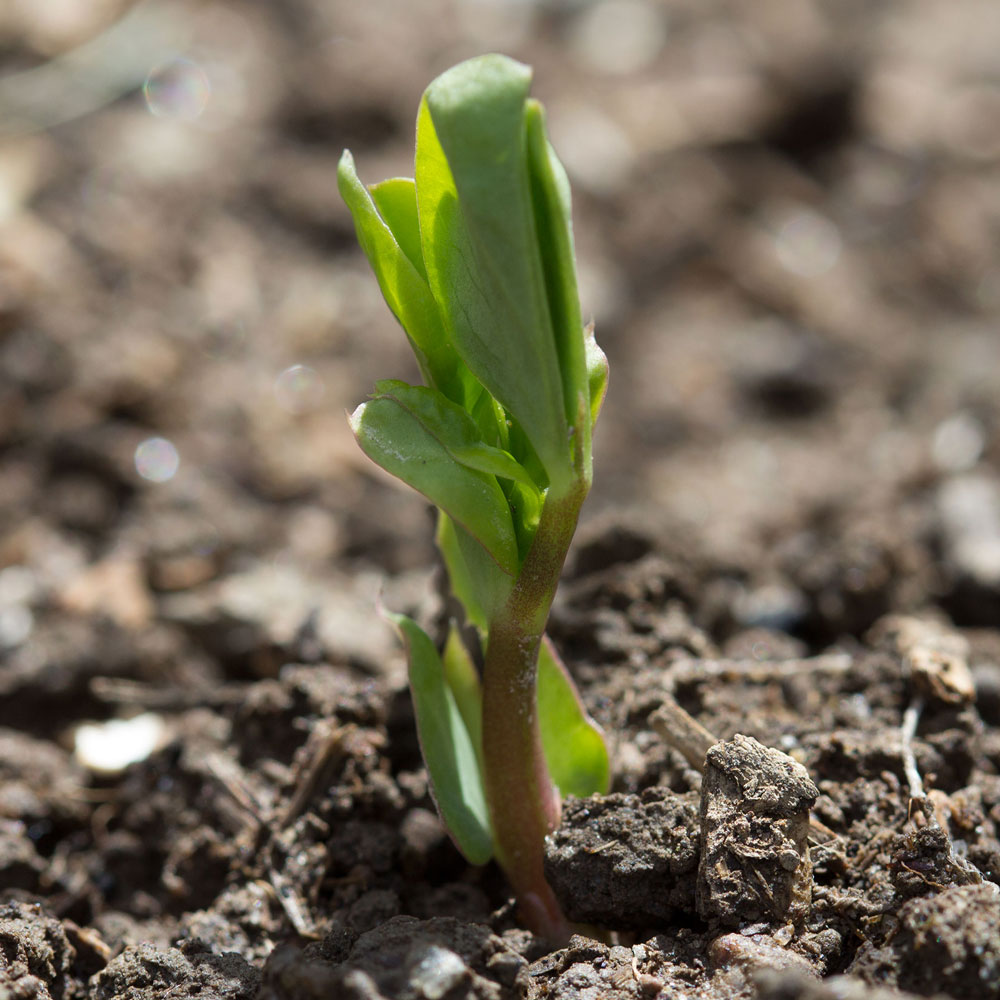
World Soil Day
by Abra Brynne, Executive Director
It is everywhere and pretty much always underfoot. Soil is foundational to so much life on earth and yet is so rarely appreciated for the wonder that it is and all it contributes. December 5th is World Soil Day, which provides an opportunity reflect on and celebrate soil.
According to the Soil Conservation Council of Canada, just one teaspoon of healthy soil contains more organisms than there are people on earth! That fact is mind boggling and points to the extreme complexity of this life underground. Increasingly, people are recognizing the role that healthy soils play in the battle to address the negative impacts of climate change.
Yet soils are under threat everywhere around the world. Soil erosion destroys ecosystems, undermines our ability to grow food, and lessens our ability to reverse the harms from climate change. Desertification is directly linked to poor soil health, the loss of soil organic matter, and climate change.
This December 5th, and every day, let’s honour, cherish and strive to protect and expand
healthy soils here and around the planet!
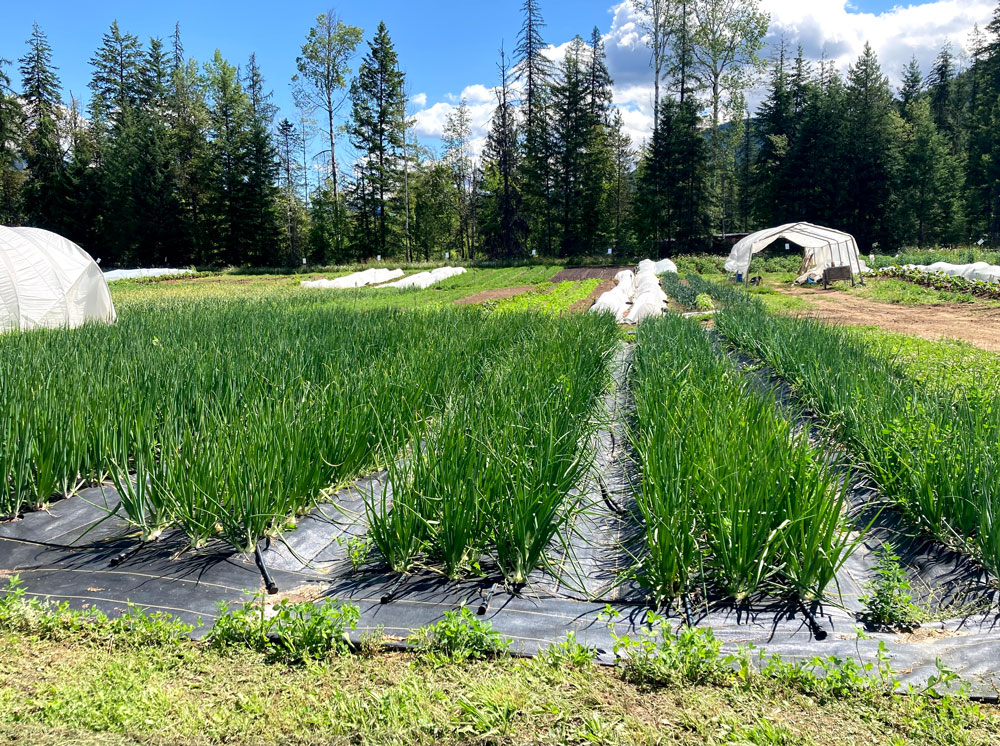
Navigating Uncertainty
By Abra Brynne, Executive Director
Nine months in, we have all mostly become resigned to the reality of the COVID-19 pandemic. It is almost hard to remember a time when it did not dominate our lives and all the news sources.
However, in the early weeks and months of the pandemic in Canada, we were all navigating in the dark, or at least without a lot of light to shine on the right path forward. The Food Policy Council established Pandemic & Food Systems Roundtable with the goal of supporting those involved in food systems (farmers, food processors and businesses, non-profits, local government) who live and work in the Columbia Basin to discuss our work, our challenges and to help find a path forward in this pandemic – for the immediate and the long term. Our first Roundtable met on March 31st and then weekly thereafter through those early months.
At all meetings of the Roundtable, the core function is the exchange of information and updates from our respective communities, businesses and parts of the food system. In the early months, we supported each other with ideas, our best interpretations of the current and ever-evolving information about the pandemic, and what the practical responses should be as we collectively navigated the uncertainty. In those early days, it was unclear if farmers markets would even go ahead - big questions for farmers facing decisions about what and how much to plant when market channels may not exist come harvest time.
Happily, food and the measures to connect farmers to eaters were readily understood to be among the services and sectors deemed essential. Farmers markets did proceed in many of the communities where they were established, with the now familiar physical distancing and mask requirements. As the season progressed, through the Roundtable, we were able to share information that confirmed hopes, and sometimes fears, about how our farmers would fare at the markets. The Roundtables have enabled the exchange of key information to better understand regional disparities and the measures that could be taken to better support food producers in the Columbia Basin.
Now, nine months into the pandemic and at the close of harvest season for many of our farmers, we have an opportunity to check in, reflect on how our communities, farmers and collective food security fared through this crazy period, and what the year ahead may hold.
The Roundtable now meets monthly, on the first Thursday of the month. We welcome anyone involved in food systems who resides in the Columbia Basin. Come learn from and be supported by your peers as together we forge a stronger, more resilient food system in our region.

Join us Dec 3rd for the next Pandemic & Food Systems Roundtable on Dec 3rd

Join us for the next monthly Pandemic & Food Systems Roundtable happening on Thursday December 3rd from 1:30-3:00pm Pacific / 2:30 – 4:00 Mountain.
These monthly meetings provide space for those involved in food systems (farmers, food processors and businesses, non-profits, local government) who live and work in the Columbia Basin to discuss our work, our challenges and to help find a path forward in this pandemic – for the immediate and the long term.
Click the link to join us online via Zoom: https://us02web.zoom.us/j/86807443163?pwd=RzFIQnprYmNzRml5aTVkSEpiVDNRZz09
Join us Nov 5th for Pandemic & Food Systems Roundtable
Join us for the next monthly Pandemic & Food Systems Roundtable happening on Thursday November 5th from 1:30-3:00pm Pacific / 2:30 – 4:00 Mountain.
These monthly meetings provide space for those involved in food systems (farmers, food processors and businesses, non-profits, local government) who live and work in the Columbia Basin to discuss our work, our challenges and to help find a path forward in this pandemic – for the immediate and the long term.
Click the link to join us online via Zoom: https://us02web.zoom.us/j/86807443163?pwd=RzFIQnprYmNzRml5aTVkSEpiVDNRZz09

World Food Day 2020
A parable about land
By Abra Brynne, Executive Director

Imagine you and your family live in a lovely house. It is the place you grew up in. The doorframe into the mudroom has notches that documented yours and your siblings growing bodies over the years, as you got taller and taller – and now there are new notches tracking the growth of your own children.
Out in the backyard, there is the most awesome tree in whose branches you played, swung and built the tree fort, and from those lofty heights you surveyed the world around. Nearby, there is the “pet cemetery” where generations of cats and dogs have been lovingly buried at the end of their lives. You experience deep joy watching your children discover the delights that kept you entertained and that taught you so much throughout your childhood.
The broad expanse of the yard allows for a variety of fruit and nut trees. The vegetable garden is the envy of the neighbourhood, for both its beauty and abundant annual harvests that provide a secure source of food that is preserved and savoured over the long winter months.
Your partner and children now live there with you, carrying forward the traditions from your childhood and creating new ones with the next generation. There is space for all of you to play, work, and eat - to live together. Your family is strong, content, and thriving.
Then one day, some people come to the door. They are new to the neighbourhood and do not yet have a place to stay, know where the best sources of food are, or truly understand just how cold a Canadian winter can be. So you welcome them in. The guest bedroom is free so it seems only appropriate to share the space, even though it is not clear how long they will be staying.
Soon their belongings are spread around the house. They and their activities take up more and more room and it is harder for your family members to access the bathroom when they need to. The kitchen table is too crowded at meals and the extra people means that your stores of food are diminishing rapidly.
Things are getting more and more uncomfortable and the “guests” start to seem threatening. They invade every aspect of your home, use your tools, play, eat and sleep in the spaces that once were yours without question. Eventually, you and your family are forced from your home. You are allowed to stay on the property, but you must confine yourselves to one small corner, along the fence-line and are not permitted to enter the house nor even to harvest from your once abundant gardens. As winter sets in, you and your family are more and more miserable and worried about how to survive.
This is a story of injustice, readily recognized by most as such. It is also a parable that seeks to convey that land is foundational to reconciliation with Indigenous peoples. Reconciliation will never be realized as long as settlers are unwilling to acknowledge and address the profound wrongs of stealing the land and waters from the First Peoples of what is commonly called Canada.
To this day, the vast majority of the region called British Columbia is un-ceded Indigenous territory. We, the settlers, did to Indigenous peoples of these places where they have lived since time immemorial, what the guests did to the happy homeowners in my parable. Using the might and the legal systems of Canada and British Columbia, we have defined small reservations within which the Indigenous Peoples are supposed to remain and be able to meet their cultural, spiritual and material needs. And over all the land – in or out of reservations - we have imposed a foreign legal system and regulations. We have pushed the Indigenous People to the corner of what was once their “yard” and imposed a new set of customs and laws.
I know that food is intimately connected to land. And I have also learned that silence is violence in the context of systemic racism. So on this World Food Day – and every day - I acknowledge that I am a squatter on Indigenous Land.
As a settler, I do not know what a path to land justice will look in the places that I call home. But I do know that if I want to be in right relationship with the land, I must enter into courageous, inevitably uncomfortable, but necessary conversations with the people who are Indigenous to this place – conversations that will lead to changes I cannot now imagine.
In 2020, the Food Policy Council formally integrated into our work addressing systemic racism in food systems. We are in the process of establishing a justice, equity, diversity and inclusion working group so that we can more deeply understand and act upon the many ways in which systemic racism affects who has access to land and food, and who may be harmed by the ways in which we are fed.
If you are interested in our work, please reach out to us.
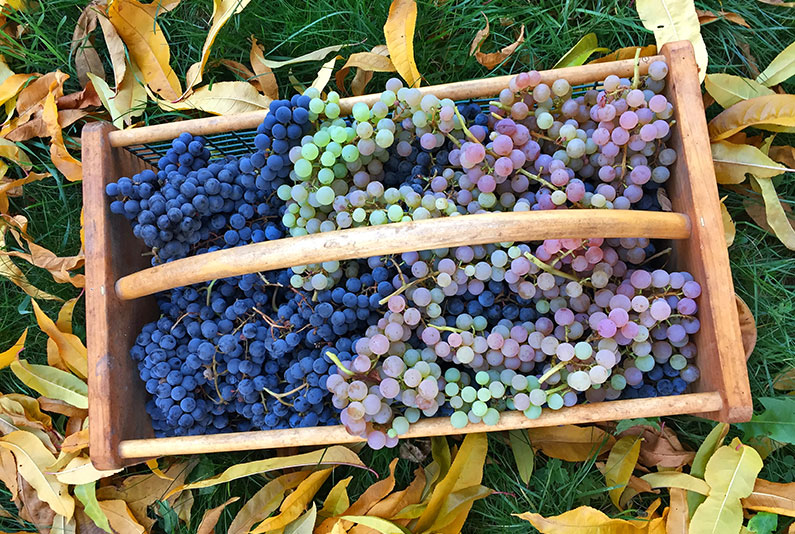
Helping Out
by Abra Brynne, Executive Director
It is early October and it's still warm enough to have the window beside my desk open. I can hear gardening sounds that keep distracting me. Across the alley from my house lives an elderly Italian woman named Domnica. She is trimming a very impressive grape vine on her property.
I moved to this neighbourhood at the end of January this year. We had just started to locate all our belongings and enough space amongst the detritus of our lives to begin looking outward towards our new neighbours when the pandemic hit BC. Suddenly all my plans for connecting with our new neighbours, of finding common interests over the fences and moving towards shared meals and garden harvests - they all ground to a sad halt.
It may be because I am from a family of 13 people, but i am driven by a deep instinct to connect with others and to see those connections as vital to my well-being and life. Domnica and I exchange smiles and waves in keeping with COVID guidelines for keeping distance from those not in my bubble. But here I sit in frustration, having to ignore my passionate urge to go help her trim her vines. And I know that my offer of help would be more for me than for her: I would get to learn from a deeply experienced home gardener about how to properly tend grape vines, all in exchange for the offer of my slightly younger brute strength in clipping, raking and cleaning up.
Our food security, community well-being, and resiliency in the face of the inevitable challenges of life are all best served through relationships - with place, with people, with our cultures.
And maybe next year, I will experience the joy of helping Domnica with many garden tasks and carrying on the important tradition of learning from our elders…
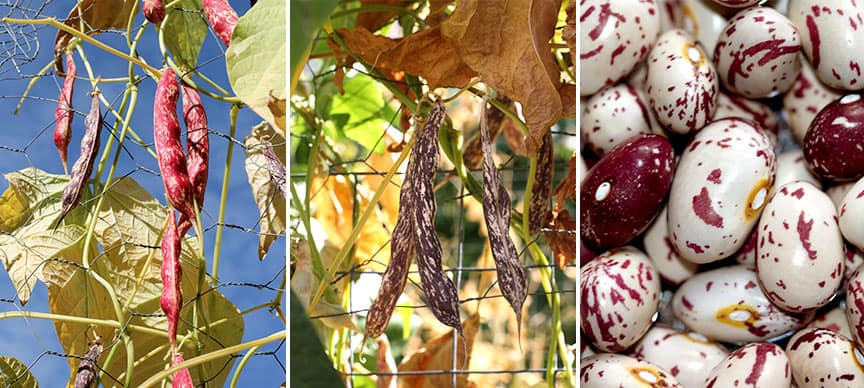
Brilliant Beans
by Abra Brynne, Executive Director
I gathered my second harvest of dry beans the other day, when we had a long enough break from autumn rains to dry down the pods. It was a welcome exercise that followed an earlier and larger harvest. It was during my first harvest that I took note of the bean pods not yet ready and still others far from harvestable. This obligation to return to complete the harvest once, perhaps twice, is nature’s way of ensuring that there will always be food and seeds, of fostering food security. Large monocultures and machine harvesting do not lend themselves to this kind of repeated harvest. Nevertheless these staggered harvests are a vital part of biodiversity being preserved by peasant, small-scale farmers, and gardeners around the world. Staggered harvests help to preserve the genetic variability of our seed supply and promote a diversity that ensures that there will always be some that can withstand the challenges of poor weather, pests, disease and deleted harvests.
Each spring I gather up my precious cache of bean seeds and plant as many as I can make space for. The colourful pods and harvested beans are a joy to grow and demand little of me over the course of the season, beyond a high trellis up which they climb. My beans have storied names, like Annie Jackson, named after the woman who brought her beans from Russia to southern Manitoba, bringing the taste of home with her across the ocean. My other favourite bean is also from that part of the world, a heritage Doukhobor bean for which I have never been able to find a tall enough bean pole. It always reminds me of the children’s tale, Jack and the Beanstalk, except the gold is in the precious, nutritious beans that I harvest each September. These beans have been grown out for so many years in the Kootenays that they are perfectly adapted to our short seasons. Each September, the leaves turn yellow and fall away, leaving gorgeous striated pods to more easily dry down on the exposed vines in the sun
I grow drying beans on my small urban lot because they are nutrient dense sources of protein that I can produce myself. What do you grow that nourishes your body and soul and brings you joy?
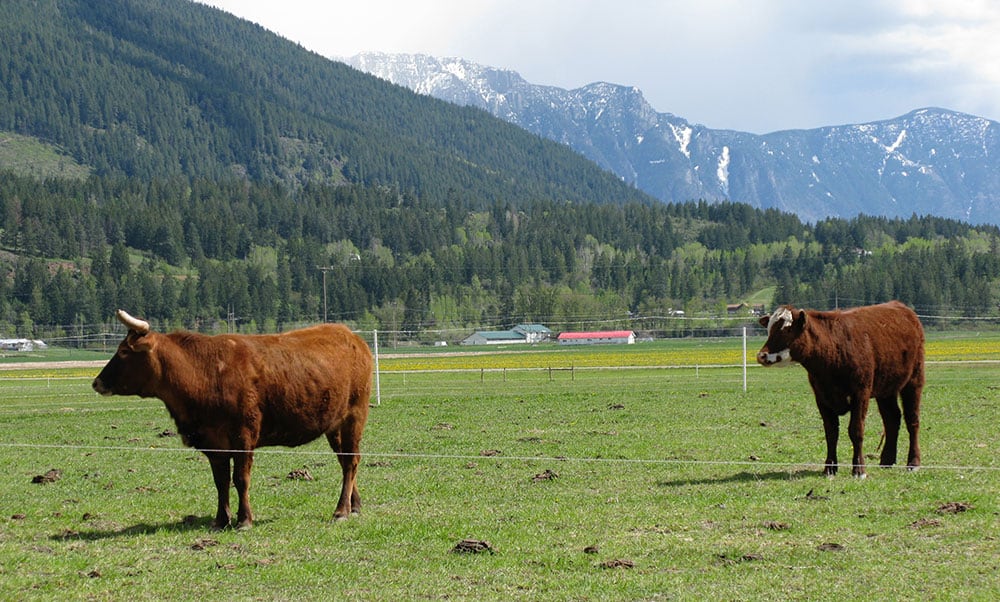
Rural Slaughter Modernization - Call for Input by November 16
The BC government has released an intentions paper and is seeking input on how to make slaughter more accessible and viable for livestock producers.
Fields across the Central Kootenay have long been home to assorted grazing animals. From the earliest settlers here, livestock have made important contributions to farm income streams, community food security and to soil fertility. For many people in rural and urban communities, the provisioning of food has included the culture and practice of sourcing meat directly from the farmers who raise the animals.
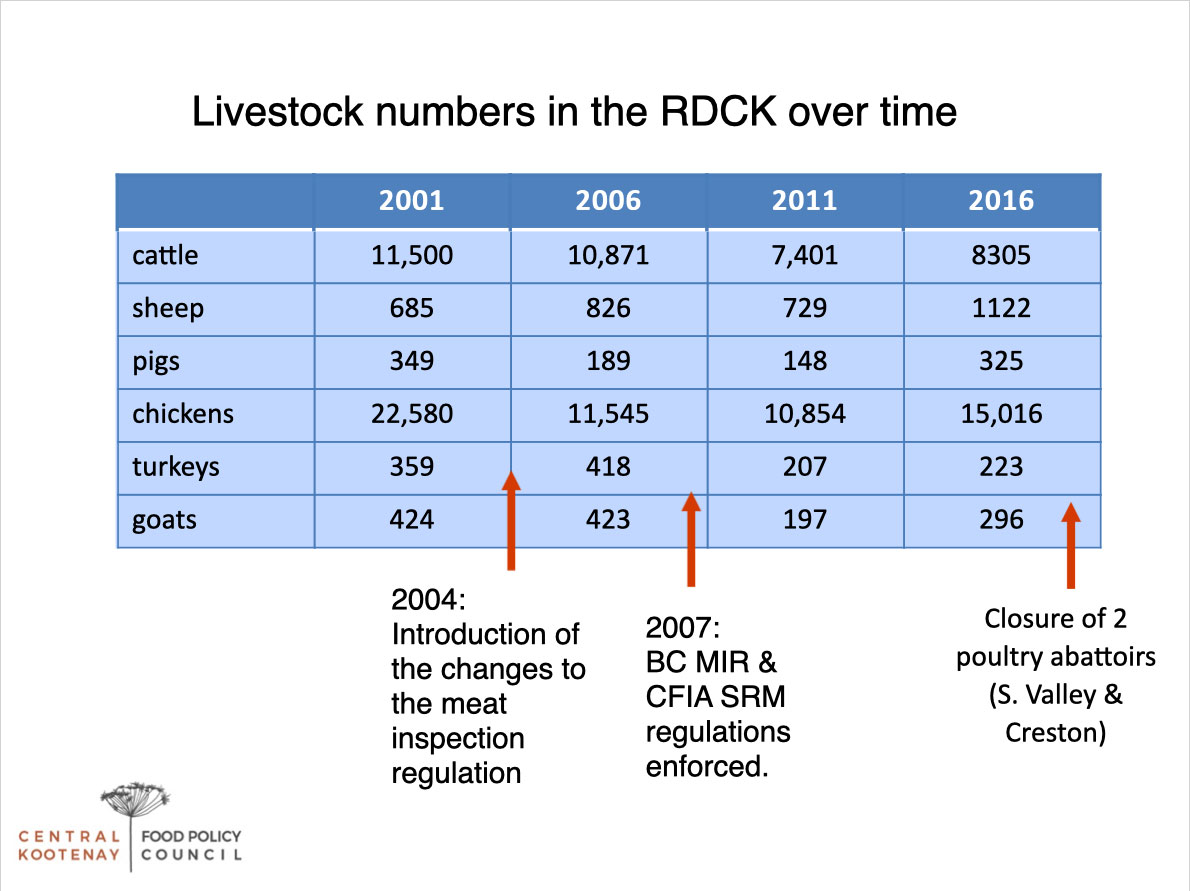
The change in the BC Meat Inspection Regulations, implemented in 2007, changed all that. Suddenly, a long-standing practice was illegal: farm raised meat could no longer be sold or even given away unless it had been processed in a licensed abattoir. In 2007, no such abattoirs existed in our region. According to a 2008 survey of farmers in Areas E, G, H, and I, 98% of the livestock producers had either reduced or completely eliminated their animals due to the inability to legally slaughter them.
Following a great deal of effort and huge investments, the Central Kootenay now has two licensed abattoirs, one processing chicken and the other cattle, pigs and sheep. Both are located in the Creston Valley. As a result, large portions of the Central Kootenay still do not have ready access to abattoirs.
There may be reason to hope that this can change. The Ministry of Agriculture has circulated a Rural Slaughter Intentions Paper, seeking input from British Columbians on how to make slaughter more accessible and viable for livestock producers.
The tone and content of the paper is encouraging but the best outcome of the consultation process depends on submissions from those who wish to see rural meat supply chains legally re-established at a level that could actually serve both the volume of livestock and the level of demand amongst consumers.
Please take the time to read the Intentions Paper and then let the government know what you think. Comments are due by November 16, 2020 and can be submitted by email to bcmeatinspection@gov.bc.ca. See the report for more details on how to submit feedback.
COVID-19 & Food Systems - New Meeting Schedule
The Food Policy Council continues to engage with those involved in food systems (farmers, food processors and businesses, non-profits, local government) who live and work in the Columbia Basin to discuss our work, our challenges and to help find a path forward in this pandemic – for the immediate and the long term.
We are now meeting monthly on the first Thursday of each month from 1:30-3PM Pacific / 2:30 - 4PM Mountain.
Click here for the Zoom link and an updated list of meeting dates.
Migrant Workers and our Food System

On August 12th, The Food Policy Council was pleased to partner with Interior Health in a presentation on Migrant workers provided by Natalie Cryderman and Mio Lainchbury 5th year dietetics Interns.
Natalie and Mio presented the outcomes of their research and answered questions from participants. This was the final project in Mio and Natalie’s internship and we wish them well in their new careers!
Their presentation can be read here.
COVID-19 & Food Systems
The Food Policy Council is now hosting bi-weekly meeting to provide space for those involved in food systems (farmers, food processors and businesses, non-profits, local government) who live and work in the Columbia Basin to discuss our work, our challenges and to help find a path forward in this pandemic – for the immediate and the long term.
Meetings are on every second Thursday at 1:30PM Pacific / 2:30PM Mountain starting on June 18th.
Click the link to join us online via Zoom: https://tinyurl.com/y86bjfhh
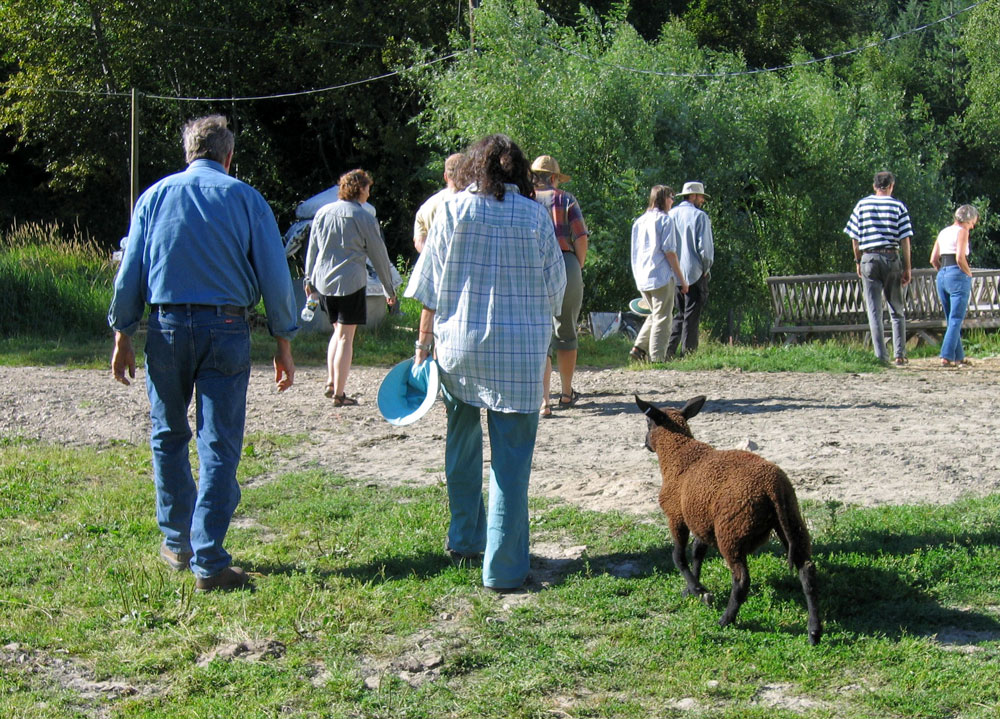
Righting the World – the journey towards food security
by Abra Brynne, Executive Director
When my son was little, he had an imaginary version of the world around him that he called “backwards land”. Since I myself did not inhabit backwards land, I had to assume that things were somehow opposite to what I experienced.
More recently, I have wondered about the wisdom of my wee son as I observed the antics and culture predominating in North America. As a one-time classics student, I have not been able shake the image of Emperor Nero fiddling while his Rome burned. It feels like we have all been dancing and spinning faster and faster with the distractions of accumulation and social media in order to avoid facing the reality of the world around us – a world burdened and scarred with the repercussions of extractive, exploitative practices that have resulted in barren, lifeless landscapes, undrinkable water, climate change, and increasing poverty for the many juxtaposed with unimaginable wealth for a privileged few.
COVID-19 may have righted our world – perhaps only temporarily – as it has made it acutely clear what goods and services are actually essential. It has also driven home that it may not be in our individual and collective best interests to have few or distant sources of essential supplies such as the precious N95 masks and, of course, our food.
We have been reassured by representatives of the grocery industry that there is no food shortage. And we are all being exhorted to not hoard. Despite this, many are “stocking up” as they used to say. I would suggest that this has much to do with a natural and innate desire to stave off starvation. Both my parents’ families barely made it through the depression of the 1930’s, suffering through years of hunger and malnutrition. As a result, my childhood household was structured around food provisioning for my family of 13. Our farm was designed to exchange tree fruit for cash to secure other family needs and, just as importantly, to provide the bulk of our fruit, vegetables and protein needs.
Up and down the supply chains of the food systems that meet our dietary needs and wants, people are involved. People who may now be under quarantine, self-isolation, or are falling ill to COVID19. Despite the fact that food has been included in the list of essential services, there is no means to ensure that the workers who enable us to access food are immune to this virus. A partial list of such workers includes those who tend the crops in the field, workers in abattoirs, fishers, food processors, those who harvest and package the food, and the truckers who move so much of our food across the continent. They are the vital links in the supply chain and they are as susceptible to all the fallout of this pandemic as the rest of us. When they succumb, the link they represent in the supply chain fails.
The impact of the pandemic is and will be felt differently by the different sectors that all feed into our food supply. Two key factors will be “shelf life” (how well and for how long they store) and how heavily the food relies on human labour.
The assurances that there is a plentiful supply of grains and legumes is likely reliable for many months to come, even without new harvests to replenish them, based on the globalized structure and few large corporate players who store and distribute them from various favourable locations around the world. The same could likely be said for the stock of shelf-stable canned goods, from soups to pasta dishes, to fruit. These all have reasonably long shelf life. Grains and legumes will see a loss of moisture and nutrients over time but will still be edible.
However, it is a very different story for perishable foods. Many perishable foods are highly dependent on people to plant, tend and harvest them, particularly fruits and vegetables intended to be eaten fresh. Some have been able to integrate equipment that reduces or removes the need for humans. But across Canada, we rely on 45,000 temporary foreign workers each year to tend to the food that will mostly end its life in the refrigerators of Canadians. While the work that they do has been included as an essential service, there are currently few options for those not already in the country to get from, Mexico for example, to Ontario or British Columbia.
Animal products have varying needs for humans. Many dairies across Canada have shifted to robotic milkers, allowing the cows to milk on their own schedule. Other supply managed sectors like chicken and eggs have well honed supply chains that ensure that the production and distribution happen consistently week by week from farm to consumer. However, they too rely on humans to ensure that each link in their respective supply chain – from fertilized eggs to incubators to barns to slaughterhouse or egg grading station – all rely on humans for each step in the process and for the transportation between them.
Truckers have long been invisible in the food system and yet they are a heroic vital link, particularly for perishable product. With the shut down of public spaces across the continent, truckers are being deprived of places to use the washroom, to eat, and to rest safely. In addition to depriving truckers of ready access to some of the essentials for their work day, they too are as susceptible as the rest of us to contracting the virus – and perhaps more so since many of them travel widely.
The current understanding of this virus indicates that we are at very low risk of contracting the virus from the food we eat. However, as was recently reported in Bloomberg news, “Massive operations where workers pick berries together, cut meat side-by-side on a production line or load warehouse trucks in sometimes close proximity risk slowing down. Some facilities may have to shutter for cleaning and worker quarantines. Produce could end up rotting in fields if there aren’t enough healthy workers.”
Despite the fact that less than 2% of our population currently farms and even fewer are commercial fishers, there are farms and local food economies where we live, and even the landlocked may be able to access direct-to-consumer fish options. This current pandemic is a huge opportunity for us to realize the importance of vibrant, accessible, local food systems – and to do something about it. A growing local food economy may also be a new employment opportunity for those whose sectors have been hugely impacted by the pandemic.
In our own spaces and communities we can get involved in growing food, whether that be in our front yards, on balconies or in community gardens (protocols are being developed across the country to enable safe use of both community gardens and farmers markets during the COVID-19 crisis). If you are new to gardening and there are no organized groups in your area, walk down the alleys of your community and take note of which yards have established food gardens. Then regularly consult those experienced gardeners from a safe physical distance as the season proceeds. Focus on what you can grow and also on what you could not readily procure from area farmers.
We need to rebuild our food skills and awareness of the seasonality of foods. Eating whole foods and with the rhythm of the local seasons will provide us with fresher, healthier and less expensive food. As fresh foods from other parts of the world become scarcer where we are, we will have to revisit our privileged diets and adjust our expectations and food practices accordingly.
Few of us will be able to produce all our household’s food needs. Seeking out and proactively supporting local farmers, fishers, and food processors can help rebuild local food economies, for the immediate and the long-term. Input – through forums, recommendations to those business owners, and through our purchasing habits – can help to refine the local food supply to reflect more closely our nutritional needs. This in turn would help to ensure that as this pandemic continues to unfold, and for any future such crisis, we could have a reasonable level of local food self-sufficiency. A seminal work published in 2006 by Christian J. Peters, Jennifer L. Wilkins and Gary W. Fick entitled “Testing a complete-diet model for estimating the land resource requirements of food consumption and agricultural carrying capacity: The New York State Example” provides a useful model for those seeking to shift production to match consumption needs.
The carrying capacity of Turtle Island more than sufficed for the Indigenous people of this continent. When Europeans first encountered them, the Indigenous people here were amongst the tallest on the planet, a clear indication of generations of adequate and healthy diets. Across Canada, as many focus on reconciliation, we must do all we can to respect the Indigenous communities that are self-isolating in order to protect their elders, their language and culture carriers. And we must provide them with the land and water access, the necessary funds and other resources to rebuild and expand their traditional food ways.
As many have observed, this shared global crisis provides an opportunity to revisit how we have lived on this planet, with each other, and with other beings. Among us, the most resilient and creative in the face of our dominant culture and systems of commerce are those who have been marginalized by them. They have had to be in order to survive. Now that the entire planet is focused on surviving, we must ensure that when we come out the other end, we have found ways to collectively live better on this planet. We can revisit our assumptions, the values that we hold, and the priorities that we have in order to adjust, rebuild and create spaces and food systems that are just and that truly contribute to the wellbeing of all.
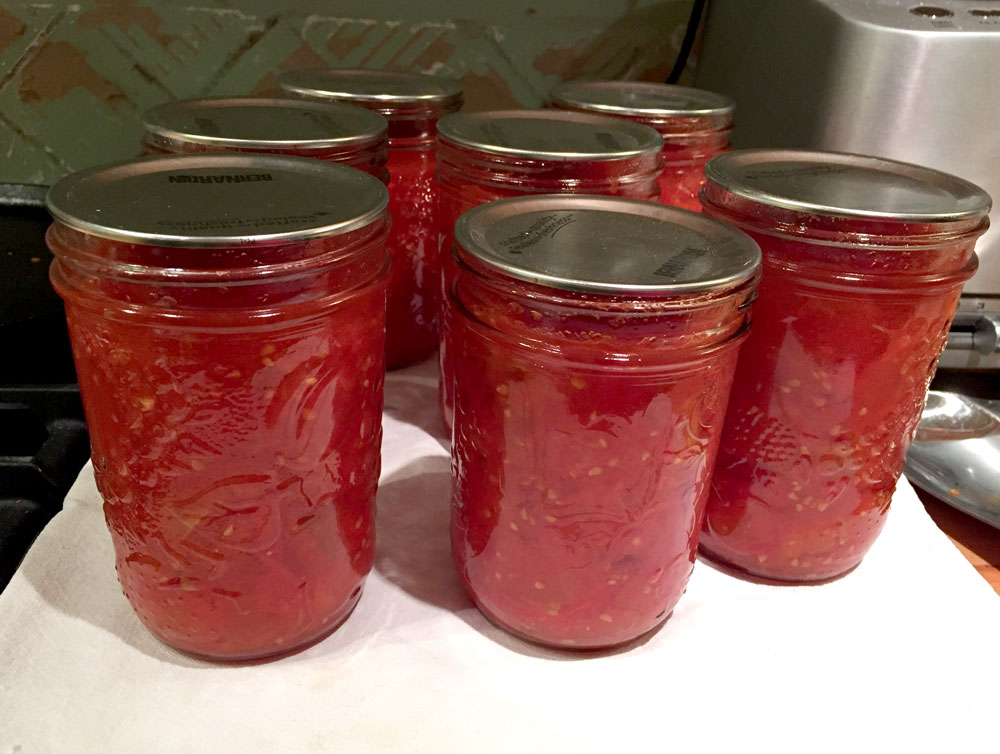
Y2K was a dry run: Reflections on COVID-19 and food
by Abra Brynne, Executive Director
In the late 1990’s, I spent the better part of 2 years educating people about how to grow, make, and preserve food in their own homes. It was part of a pro-active measure taken by my then employer, the Kootenay Country Store Cooperative in Nelson BC, to respond constructively to the concern that many were feeling about the possible havoc that Y2K might wreak. Then, as now, people were concerned about the security of their food supply—though less so about toilet paper. If no fuel was available to run the trucks that bring so much of our food, how could we best protect and prepare ourselves locally?
Twenty years on, this novel coronavirus outbreak has made it blatantly apparent that our world is connected and very, very small. As each day passes, it is hard to avoid the news about the dramatic increase of cases in country after country. We are seeing unprecedented closures of borders and commerce in the attempt to contain the spread. And around the globe, people are being told to practice “social distancing” in order to insulate themselves from possible exposure to the virus. The virus is globetrotting while our lives are narrowing into the confines of our homes, if we are lucky enough to have one.
What this coronavirus has made blatantly clear is that relying on long supply chains for the essentials of our lives makes us very vulnerable. In almost thirty years of talking and educating about food systems, my best attempt to make this tangible in the past was to reference highway closures due to avalanches. The fragility of long supply chains is now all too obvious as hospitals struggle to acquire enough masks, never mind ventilators.
It is impossible to know what next week will bring for this pandemic, nor how this will all play out here and around the world. But I hope that this prompts more to embrace the value of local food systems. There is no inherent moral superiority to local food. However, as the breakdown of global supply chains demonstrates, having the source close at hand provides greater security of access. And when it comes to food, which every one of us needs daily, it seems wise to ensure that the basics are covered locally.
Most of us rely on commerce or the marketplace to source food. There are those, however, who rely on their own skills and work to obtain at least a portion of their food. To augment food security for Indigenous people, wherever they may be able to practice traditional ways, we must ensure that they have access to the places and waterways from which they can source their foods and medicines. For those who raise and grow food in their backyards or fields, we must ensure that local bylaws encourage and enable such practices. And for those of us who rely on commerce to obtain food in exchange for money, we must rebuild our local food systems.
We are being told that there is no shortage of food. Nevertheless, no matter how large the distribution centres of Canada’s large grocery chains, they are still finite relative to our ongoing need to eat. Of the commodities California produces, it exports almost 40% of the USA total, shipping $3.3B in fresh fruits and vegetables to Canada in 2017. California is currently one of the hardest hit states in the USA by COVID-19. It is also a state with an agricultural sector that relies heavily on foreign workers to tend the crop and collect the harvest. Add to that the pressures of climate change and the long-documented decline of fresh water supplies in California, and it becomes pretty clear that relying on California in the long term for our fresh produce is unwise.
There are things that we can do in our homes and communities in the short term, but the work of rebuilding local food systems and supplies is a long-term project. In my lifetime, I have watched the loss of infrastructure for local food systems—from flash freezers and cold storage to canneries, from abattoirs to veterinarians; they have all disappeared from the landscape with few exceptions. This has not been by accident. It is the outcome of public policy going back to a 1969 Federal Task Force report that recommended that “1/2 to 2/3 of Canadian farmers be moved out of agriculture”. Public policy derived from that Task Force’s findings promoted “efficiency” and export markets over the survival of family farms and fishers across the country, which has achieved its sad goal with the massive reduction of farmers and fishers in the past six decades.
The Federal Task Force of the late 1960s proposed that “success can only be had by having fewer units. That is the only way to have family farms capable of a decent income to have fewer of them.” COVID-19 has compellingly demonstrated that relying on “fewer units”, often far away, leaves our communities highly vulnerable when it comes to the basic necessities of life.
Which is all to say that there is great wisdom in rebuilding local food systems, but it will necessitate changes in policy at all levels of government. It will also require an increase in local market options for producers, something resembling domestic fair trade so that farmers and fishers receive fair compensation for their vital skills, work and investments, and a real and sustained increase in the number of people willing to enter these vital trades for our collective good.
Prior to the outbreak of COVID-19, most Canadians spent less than 10% of their disposable income on food—even less if you remove food consumed out of the home at restaurants and cafes. To do our part in rebuilding local food systems, we must privilege food in our budgets.
When we let our values and priorities determine the direction and character of local programs and policies, we strengthen our communities and local food systems and ensure that people do not go to bed hungry.
There is much to be done to rebuild our household and communal food security and move towards food sovereignty—where local eaters have more control over the food supply. We need to recognize the true cost of producing food here in Canada, where we have protections for wages, environmental standards, food safety expectations and rules, not to mention a northern hemisphere climate. These all contribute to higher costs of production. We need to reflect on our core dietary needs and consider adjusting our food wants to better align with what can be grown or raised in our home foodshed. And we need to consider our relationship to the land, to the water and to the Indigenous people who were here long before we were.
As so many have said in response to the global pandemic, it is through our collective efforts and mutual caring that we survive and thrive. This is just as true for the work needed to rebuild our local food supplies and increase the resiliency of our communities.

Evidence-based Policy development project well underway!
We all know things are changing – the weather is weird any time of the year; spring freshets are not happening the way they used to and are having an impact on water levels and flooding; increased heat and wildfire smoke is affecting livestock, tree fruit and crops. What does all this mean for our region’s food systems and how might local government planning processes and documents be adapted to accommodate the changes so that our food systems can continue to be viable and thrive? By creating an evidence-base! Read more about our Project here.
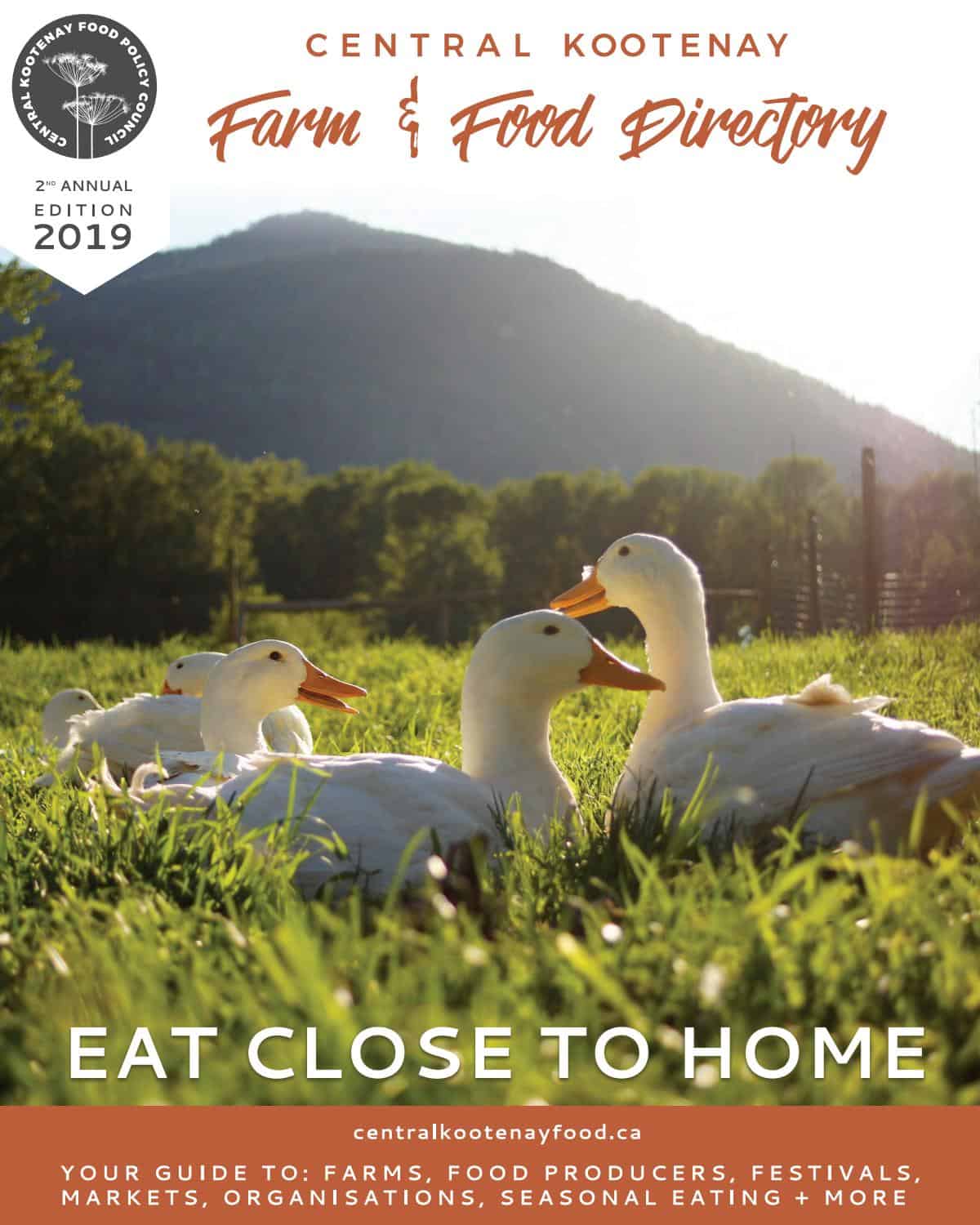
Regional Farm & Food Directory – at a location near you!

The print version of the annual Central Kootenay Farm & Food Directory can be found throughout the Central Kootenay beginning in May of each year – look for it at farmers markets, in your local library, locally owned food stores and restaurants, and tourist information centres.
The web-based version of the Directory is available year round. It works on all sizes of devices so you can take it with you on your phone when you are out and about, or browse through it more thoroughly on a larger screen at home. Explore the abundance of good food and amazing entrepreneurs to be found in the Central Kootenay!
If you run a farm or food processing business in the Central Kootenay, you can list your business for free in the Directory of Farms and Food in the Central Kootenay. A Guide has been created to help navigate creating an account and entering your information. To enter your business in the Directory, go here and look for the Register link in the top right hand corner. If you are returning to update your entry, click on the Log In link.
Evidence-based Food systems policy development project
We all know things are changing – the weather is weird any time of the year; spring freshets are not happening the way they used to and are having an impact on water levels and flooding; increased heat and wildfire smoke is affecting livestock, tree fruit and crops. What does all this mean for our region’s food systems and how might local government planning processes and documents be adapted to accommodate the changes so that our food systems can continue to be viable and thrive?
The Evidence-based policy development project proposes to answer these questions over an 18 month, phased project. In collaboration with the Regional District of Central Kootenay, Selkirk Geospatial Research Centre, the Rural Development Institute, and the Institute for Sustainable Food Systems at Kwantlen Polytechnic University, the Council will lead an analysis of geospatial data about our region to identify what factors support and which ones hinder viable, vibrant food systems. The outcomes of this research will be used to create an evidence-base for future policy development on matters like set-backs from changing waterways, for better understanding where land suitable for agriculture is also most affordable to assist new farmers getting onto the land, or to flag which farming communities are most at risk from wildfire or flooding.
The project will also include the creation and delivery of educational programming to help students and adults in the region to demystify public policy and encourage effective public participation in creating policy that will foster food security in our region. The goal of the project is to take policy development out of the realm of either ad hoc or current hot button issues and create a clear evidence base for change that will best serve the communities and land base of the Central Kootenay for the long-term.
This project is made possible with funding from the Real Estate Foundation of British Columbia. The Evidence-based Policy Development Project is made possible with funding from the Columbia Basin Trust. The Central Kootenay Food Policy Council also acknowledges the support of the the following RDCK Directors: Garry Jackman, Aimee Watson, Ramona Faust, Tom Newell, Hans Cunningham, Walter Popoff, and Paul Peterson.